



Before you pay for mental training, work out what your child actually needs help with. A player who freezes before a match has a different problem from one who plays freely until their first mistake. Another might be fine in competition but spend days worrying about selection. Buying the same confidence course for all three would be a guess.
The useful starting point is not ‘How do we make them mentally tougher?’ It’s ‘Which moment becomes difficult, what does the player do then, and what would they like to do differently?’ That gives you something specific to practise and a fairer way to judge whether a programme is worth paying for.
If pre-competition nerves are the main concern, our guide to dealing with nerves before competition explains practical starting points.
Mental training involves learning and practising skills such as preparing for pressure, managing attention, setting goals and responding to setbacks. The right option depends on what the player wants to learn, their age and the support they need. Here’s how I’d make that decision.
What does mental training actually teach?
Mental training is often sold as confidence, resilience or mental toughness. Those are outcomes or broad descriptions, not a lesson plan. Ask what a player will actually practise, where they will practise it and how they will know when to use it. A useful programme should be able to show the link between a sporting moment, a skill and an exercise.
Look for skills with a clear purpose. A preparation routine gives a player something familiar to do before competition. Attention exercises help them notice when they’re thinking about the previous mistake rather than the next decision. Goal-setting gives them a way to focus on actions they influence instead of selection or results alone.
For example, a young tennis player who rushes between points could practise a simple between-point routine during training: turn away briefly, choose a target and get ready to receive. A netball player worried about selection may need something different: a plan for where to direct attention during training rather than constant checking of the coach’s reaction. Neither exercise guarantees a result. The value is having a specific action to rehearse.
For a player who keeps replaying a mistake, the skill may be noticing that their attention has drifted and returning it to the next decision. Ask the provider whether the player rehearses that response in ordinary training, rather than only hearing about it in a video.
For a practical example, see our guide to recovering after a mistake in sport.
The British Psychological Society’s youth-sport position statement discusses psychological skills including goal setting, imagery, relaxation and self-talk, with attention to developmental stage. That’s useful context, but it isn’t evidence that any particular commercial course works.
For further reading, see the British Psychological Society’s youth-sport position statement (2024).
Five signs it might be worth exploring
One difficult game isn’t a reason to enrol your child in a programme. Look for a recurring moment the player recognises and wants to change. The following are conversation starters, not a test or diagnosis.
A player might repeatedly hold back in competition despite making decisions freely in training. They might struggle to regain focus after mistakes, spend days worrying about selection, find ordinary feedback difficult to process or judge their whole ability by the latest result.
These aren’t diagnoses. And the same behaviour has different possible explanations. A child who stops taking risks might be worried about mistakes, but they might also be confused about their role, tired or responding to an overly critical environment.
Start with a conversation: “Which moments do you find hardest?” Then ask whether they’d like to work on those moments.
If the player doesn’t see a problem, avoid turning a parent’s frustration with results into a compulsory mindset project.
When should young players start?
Young players don’t need to wait until they’re struggling to learn how to prepare, refocus or respond to setbacks.
A younger child might practise one short cue during a game or rehearse what to do after frustration with their coach. An older player might be ready to reflect on patterns, try a preparation routine and adapt it after competition. Neither approach has a universal starting age. The British Psychological Society’s youth-sport guidance distinguishes developmental considerations across childhood and adolescence, rather than prescribing one format for everyone.
I wouldn’t choose a programme on age alone. Check whether the language makes sense to your child, whether the tasks are manageable and whether they want to take part. A long reflection worksheet won’t suit every young player, regardless of how good the lesson sounds.
Mental training should fit into their sporting life, not add another layer of pressure.
Free exercises, online programmes or one-to-one support?
Choose the smallest level of support that can reasonably address the problem. You can always step up later.
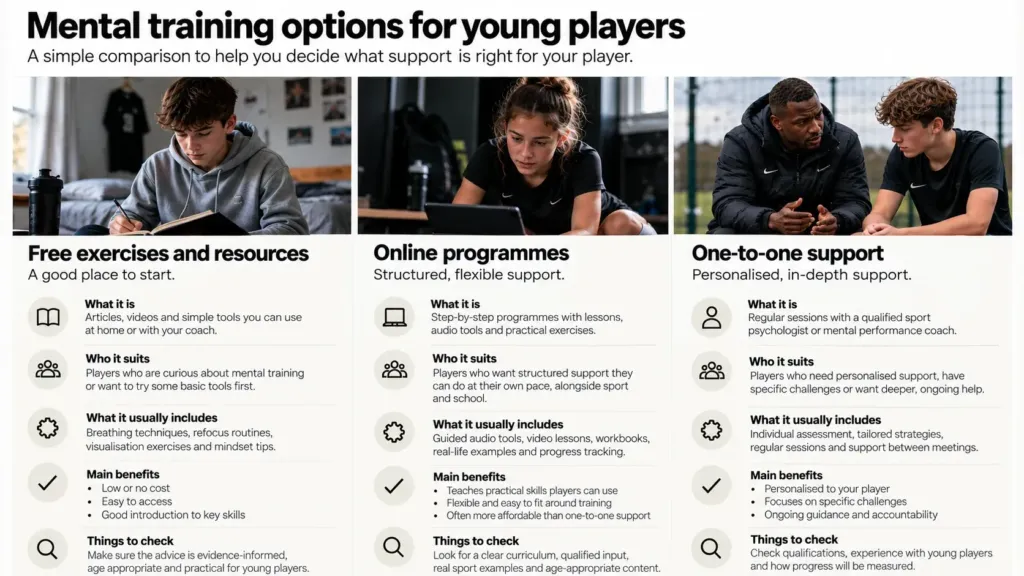
If your child wants to try one skill, begin with a free exercise. For example, they might practise a short pre-match routine or choose a cue that helps them return their attention to the next decision. Let them try it during normal training before spending money.
If they want to learn several skills and enjoy independent learning, a structured online programme may suit them. Check the sequence: does each lesson lead to a specific exercise, a chance to use it in sport and a simple way to reflect? Ask how much parent involvement is expected, whether feedback is personal or automated, and what happens if the player gets stuck. ‘Lifetime access’ is not the same as individual support.
If a player has an ongoing, individual difficulty and wants tailored help, consider one-to-one work with an appropriately qualified practitioner experienced with young people. Ask about relevant qualifications, experience with the player’s age, safeguarding arrangements, parent communication and confidentiality boundaries. A performance coach and a registered clinical professional may have different scopes of practice; the title alone is not enough to establish what support is appropriate.
If the concern involves persistent distress, mental health symptoms, bullying or an unsafe environment, a performance course isn’t the first answer. Address the underlying concern and seek appropriate healthcare or safeguarding support. A child should not be taught to tolerate harmful treatment as though the problem were their mindset.
The most expensive option isn’t automatically the right one. And starting free isn’t a sign you’re taking the problem less seriously.
Seven questions to ask before buying
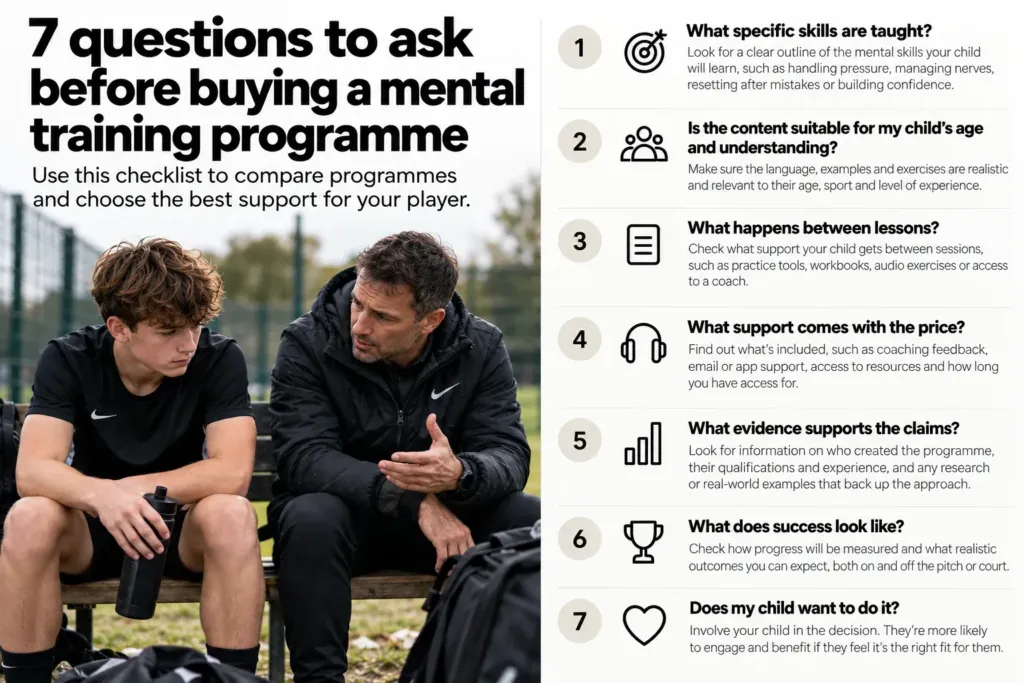
1. What specific skills are taught? Look beyond “winning mindset” or “mental toughness”. You should be able to name what the player will practise.
2. Is the content suitable for my child’s age and understanding? Check examples, lesson length and the level of independence expected.
3. What happens between lessons? Watching a video isn’t the same as practising a skill during training or competition.
4. What support comes with the price? Find out whether it’s entirely self-paced, whether parents receive guidance and whether individual feedback is included.
5. What evidence supports the claims? Be wary of guaranteed selection, statistics or rapid transformations. Research on psychological skills doesn’t automatically validate a specific commercial product.
6. What does success look like? Look for changes in understanding and habits, not a promise of better results every weekend.
7. Does my child want to do it? Ask what they hope to improve and whether the format feels useful to them.
Before paying, ask the provider to show you one complete example: a lesson, the exercise the player practises afterwards, and what feedback or support follows. If they cannot explain that journey clearly, attractive testimonials and a long list of benefits are not enough.
How to tell whether it’s helping
Agree one observable practice with your child, not a personality target such as ‘be more confident’. For example, after a mistake they might practise naming the next job and returning their attention to it. The point is to test whether they can use a chosen skill, not whether they win.
Ask them to practise the skill during training first, then during competition when an opportunity arises. After a few weeks, have a short conversation about what they’ve noticed.
Keep the review short and led by the player: ‘Did you get a chance to try it? What made it easier or harder? Would you change anything?’ If they would rather talk later, leave it. A parent’s post-match interrogation can turn a useful practice into another pressure.
You don’t need to score every match or ask for a mental performance report on the journey home. A difficult game doesn’t cancel the practice they’ve done. A brilliant game doesn’t prove the exercise caused the result.
Three useful questions are: Can they explain the skill in their own words? Have they tried it in a real sporting moment? Do they want to keep practising it? If the answer stays no, change the exercise or the support rather than blaming the player. These are practical observations, not clinical measures or proof that a course caused better performances.
When another kind of support matters more
If a child is being bullied, treated unfairly, pushed to compete while injured or exposed to unreasonable pressure, teaching them to cope shouldn’t replace addressing what’s happening around them.
Sometimes the environment needs to change.
Mental performance education is also different from mental healthcare. Persistent anxiety, low mood, significant distress or difficulties affecting school, sleep or everyday life deserve assessment and advice from an appropriately qualified healthcare professional.
And sometimes a player simply needs less on their plate. If they’re overwhelmed by training, school and expectations, adding another course may be unhelpful.
The decision tree is simple: if the player wants to try one skill, start with a free exercise; if they want a sequence and can work independently, examine an online programme; if they need individual tailoring, consider qualified one-to-one support; if safety or mental health is the concern, deal with that directly first. This is a practical buying framework, not a clinical screening tool.
Where the Player Mindset Program fits
PlayerScout offers the Player Mindset Program as one structured option for players who want to practise mental skills around training and competition. This article is a buying guide, so the same questions should be applied to our programme as to any other.
It’s an eight-week, self-paced programme covering understanding pressure, recovering attention after mistakes, staying focused, preparing for competition and developing confidence over time. Lessons and practical exercises are supported by guided audio tools.
For a player who wants a sequence to follow and is comfortable learning independently, this format might suit them. If they need personalised sessions or clinical support, it’s not a substitute for those services.
Check the current price, what’s included and the purchase terms on the programme page before deciding. Offers can change.
Read the Player Mindset Program details and current terms.
I’d still start by asking your child what they want help with. The programme should serve their development, not become another expectation they have to meet.
Was this helpful?

 9 min