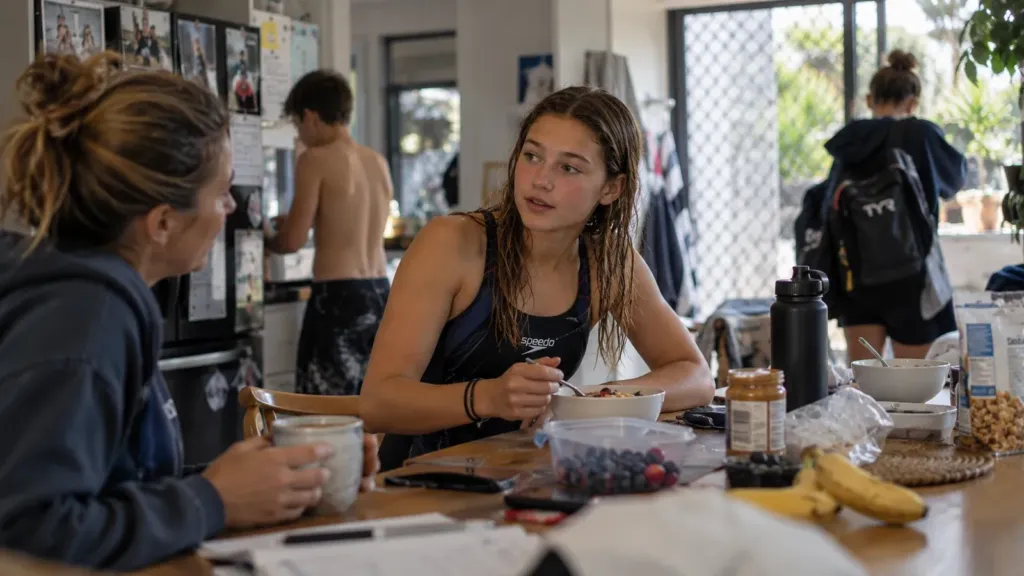






A young player sees a professional post their breakfast.
Eggs. Avocado. Fruit. Supplements. A protein shake.
The natural thought is: if that is what an elite player eats, I should eat it too.
But the photograph shows the food. It does not show why that food was chosen.
You cannot see the professional’s training load, body size, blood tests, medical history, next match, recovery needs, performance goals or the conversations they might have had with a sports dietitian.
You also cannot see what they ate yesterday, what they will eat later or whether that meal is normal for them at all.
And there is one difference that matters enormously for younger players.
They are still growing.
Sports Dietitians Australia describes adolescent players as having unique nutrition requirements because training and competition sit alongside the demands of growth and development.
So I would not teach a young player to eat like their favourite professional.
I would teach them to understand why players eat differently in the first place.
You are seeing the meal, not the decision behind it
Imagine a professional player reduces their carbohydrate intake on a light recovery day.
A 15-year-old sees the meal online and copies it before an evening training session.
The food might look identical.
The decision is not.
The professional might be following an individual plan based on that day’s workload. They might have eaten more carbohydrate at breakfast and lunch. Their next demanding session might be tomorrow. Their nutrition team might be adjusting intake around a carefully monitored training week.
The 15-year-old might have been at school all day, missed lunch, walked home, then headed straight to training.
Copying the meal has copied the end result without copying any of the context that produced it.
This applies to almost everything you see professional players eating.
The useful question is not:
“What does this player eat?”
Ask:
“Why might this player be eating this today?”
Young players are fuelling sport and development at the same time
A professional adult needs enough energy to support daily life, training, competition and recovery.
A developing player has those needs alongside growth and maturation.
That changes the conversation.
A 13-year-old should not be eating towards the body of a 27-year-old international player.
A teenager should not assume that a professional’s body-composition diet is appropriate because they play the same position or compete in the same sport.
A recent review of adolescent sports nutrition describes the simultaneous demands of growth, development and sporting performance as a central challenge when planning nutrition for young players.
There are periods during adolescence when growth itself adds substantial demands.
That is why aggressive restriction worries me far more than whether a young player has found the latest “clean” breakfast.
If a growing player is training regularly, the first question should be whether they are getting enough suitable food to support what their body is being asked to do.
The professional diet you see might be solving a problem the young player does not have
Professional sport creates highly specific nutrition problems.
A player might need to recover quickly between matches.
An endurance competitor might need large amounts of carbohydrate around a long event.
Someone in a weight-category sport might be managing body mass around competition under specialist supervision.
A professional travelling internationally might change eating times around flights and competition.
Another player might have a diagnosed iron deficiency or another medical issue that requires individual treatment.
Those strategies have reasons.
Take the reason away and copying the strategy stops making much sense.
This is where young players sometimes get pulled towards details that have almost nothing to do with their own biggest nutrition problems.
They worry about which supplement a professional uses while regularly missing breakfast.
They debate the best protein powder while arriving at training hungry.
They remove foods because an adult player said they avoid them, despite having no medical or performance reason to do the same.
The visible detail feels advanced.
The basic problem is still sitting there.
Be careful when professional players talk about getting leaner
This deserves its own section because younger players hear far more body-composition talk than adults sometimes realise.
A professional might discuss losing body fat, making weight or changing body composition.
That does not turn the same goal into a sensible target for a growing player.
Low energy availability happens when the energy left for the body’s normal functions becomes too low relative to exercise demands. Prolonged or severe low energy availability is linked with Relative Energy Deficiency in Sport, or REDs, which affects both female and male players.
The International Olympic Committee’s 2023 REDs consensus includes impaired growth and development among the potential health consequences relevant to younger players.
This does not mean every young player who wants to change their diet has REDs.
It means weight loss and body-composition advice deserves more care during development than copying somebody else’s calorie target from the internet.
If body composition genuinely needs attention for health or performance, I would want the young player supported by an appropriately qualified professional who understands youth sport.
Protein is useful. Turning every meal into protein is not
Professional players often talk about protein because protein has an important role in muscle repair and adaptation.
Young players need protein too.
But social media has a way of making one nutrient look like the whole diet.
Protein yoghurt.
Protein cereal.
Protein bars.
Protein shakes.
High-protein meals.
More is not automatically better.
Sports Dietitians Australia’s adolescent guidance recommends a regular spread of quality carbohydrate and protein sources across the day rather than treating one nutrient as the entire performance plan.
A young player eating eggs on toast, yoghurt and cereal, chicken with rice, beans in a meal, fish with potatoes or other normal combinations is already getting protein alongside other nutrients.
I would pay far more attention to whether the whole day works.
Did they eat breakfast?
What happened at school?
Did they arrive at training hungry?
Was there food after training?
Is the player eating enough overall?
Those questions tell you more than the size of the protein tub in the kitchen.
Carbohydrate gets removed far too easily
Carbohydrate is another good example of professional advice losing its context.
Elite players sometimes change carbohydrate intake according to their training schedule.
That is not the same as saying carbohydrate is bad.
A professional programme might deliberately provide more carbohydrate around demanding sessions and less at other times.
A young player sees one low-carbohydrate meal and misses the rest of the system.
Then bread disappears.
Rice gets cut.
Pasta becomes something to avoid.
The player still has school, training, competition and normal growth to fuel.
Carbohydrate remains an important fuel source for demanding exercise. For developing players, the sensible starting point is matching food to the work being done rather than being frightened of an entire nutrient group.
If you want to understand the practical side, our guide to what a young player should eat before competition shows where carbohydrate fits without turning competition food into a complicated formula.
Supplements are where copying professionals becomes even less useful
Supplements are highly visible in professional sport.
What is less visible is the decision-making around them.
At higher levels, a supplement might be used because a qualified professional has identified a specific need. Products might also be screened to reduce the risk of contamination with substances prohibited under anti-doping rules.
The International Olympic Committee’s consensus on dietary supplements says a full nutrition assessment should come before supplement decisions and notes that only a relatively small number of supplements have strong evidence for performance benefits in specific situations.
It also warns about health risks and accidental anti-doping violations from contaminated products.
For young players, Sports Dietitians Australia goes further and recommends meeting nutrient needs through core foods rather than over-emphasising supplements as a way to manipulate performance.
That is a sensible order.
Fix the food.
Fix the routine.
Work out whether a genuine problem exists.
Then get appropriate professional advice if something more specific needs addressing.
Do not start with the product because a professional player held it in a video.
Sponsorship makes the picture even harder to read
There is another question young players should learn to ask when they see professional nutrition online.
Is this advice, or is this advertising?
Professional players have commercial relationships.
A drink, bar, powder or supplement appearing in a post might be part of a sponsorship arrangement.
That does not automatically mean the product is poor.
It means the player seeing the content needs to understand that visibility is not the same as nutritional necessity.
A professional being paid to promote a product tells you very little about whether a 14-year-old needs it.
That is an important piece of media literacy for young players, especially when marketing is designed to look like normal everyday content.
Professional players have support you rarely see
A young player might see a professional’s lunch.
They do not see the sports dietitian who helped build the plan.
Or the chef who knows the training schedule.
Or the doctor reviewing blood results.
Or the strength and conditioning staff managing training load.
Or the testing around body composition.
Or the anti-doping procedures surrounding supplements.
Or the years spent learning what works before an important competition.
The food is the visible part of a much larger system.
That is why trying to create a “professional diet” at home misses the point.
Professional nutrition is not professional because the food looks impressive.
It is professional because decisions are being made around the individual player and the demands placed on them.
What is worth copying from professional players?
There are still useful things a young player can learn from high-level sport.
Look past the exact foods.
Good players often plan around training.
They do not want to arrive at competition having eaten nothing for hours.
Recovery food is available when schedules are demanding.
Fluid is thought about before the session starts.
Travel is planned.
Food is treated as part of preparation rather than something remembered when hunger appears.
Those habits transfer far better than somebody else’s breakfast.
A young player does not need the same menu.
They need the same idea that nutrition deserves some planning.
Build the diet around the player in front of you
If I were looking at a young player’s nutrition, I would start with their actual week.
When do they train?
What do they eat before school?
What food is available during the day?
How long is the journey to training?
Do they have another sport tomorrow?
Are they growing quickly?
Do they regularly finish training starving?
Are there allergies, cultural food preferences or dietary restrictions?
Does competition create nerves around eating?
Are there concerns around body image, weight, growth, periods, fatigue, injury or food restriction?
Now we have something useful to work with.
The answer might be better breakfast.
A bigger lunch.
A snack in the school bag.
Food waiting after a late session.
More thought around what players should eat after training.
Better planning across a long competition day.
None of those solutions look particularly elite on social media.
They are still more relevant than copying a professional player’s menu.
Learn from professionals without eating like them
I would never tell a young player to ignore professional sport.
There is plenty to learn from people performing at the highest level.
But learn from the thinking.
Preparation.
Consistency.
Planning ahead.
Eating around the work being done.
Taking recovery seriously.
Getting specialist help when the problem becomes specialist.
Do not assume their portions should be your portions, their supplements should be your supplements or their body-composition goal should become yours.
The best diet for a young player is not the one that looks most professional.
It is the one built around the player they are now.
Professional nutrition is not professional because the food looks impressive. It is professional because decisions are being made around the individual player and the demands placed on them.Grantley Baugh, Founder of PlayerScout
Was this helpful?

 11 min