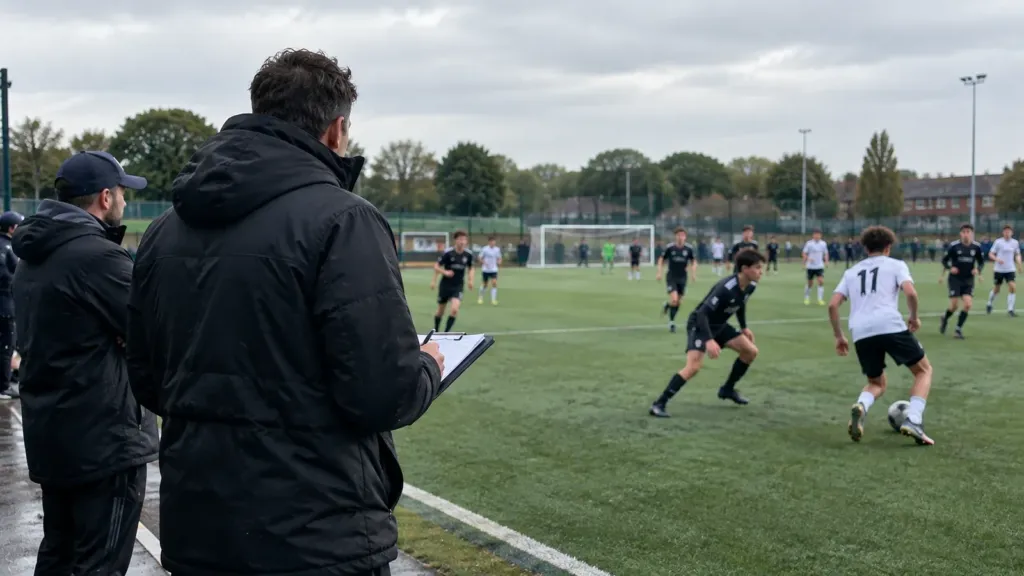



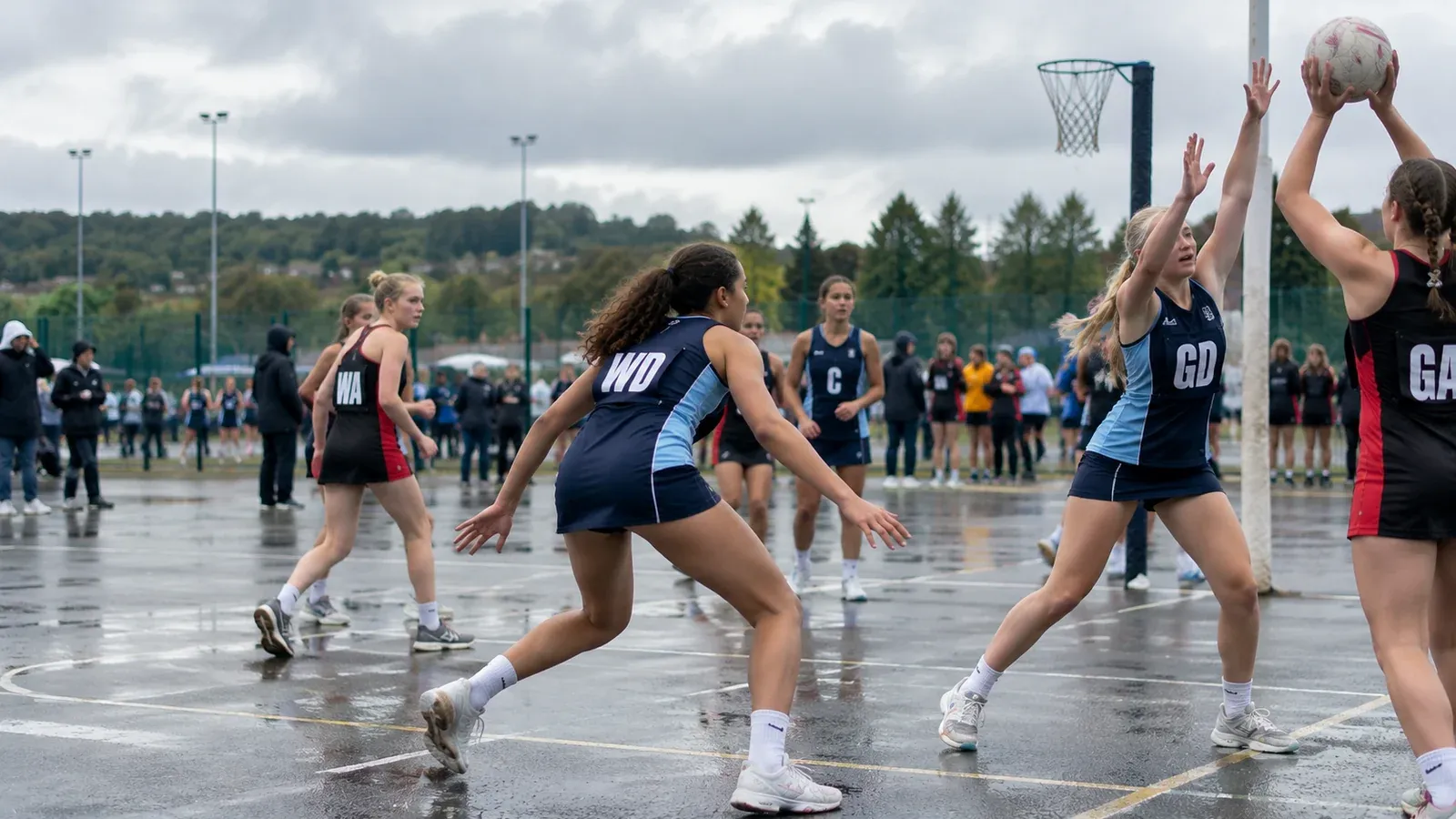

A player hears that somebody important is watching.
Their behaviour changes almost immediately.
They start looking for the difficult action. They want to score, win the point, beat somebody, produce the fastest time, land the biggest move or create whatever moment they think will make somebody remember them.
Even sensible decisions begin to feel too ordinary.
I understand why.
If you believe one performance might affect your next opportunity, you want to make sure the person watching sees your best qualities.
The problem is that trying to look impressive can make it harder for somebody to see the player you normally are.
You start choosing actions for the observer instead of the competition.
For most young players, getting noticed should be less about manufacturing a standout moment and more about making their actual level easier to see.
The person watching needs evidence, not a performance for them
Article 13 explains what coaches and scouts look for in young players and why there is no universal scouting checklist.
That matters here because once players start guessing what an evaluator wants, they often change things they did not need to change.
One player decides they need to be more aggressive.
Another thinks they need to communicate constantly.
Somebody else starts attempting skills they rarely use.
A normally composed competitor starts rushing because they think intensity looks better.
The player is no longer solving the sporting problem in front of them. They are solving an imaginary question in the observer’s head.
Research into talent identification shows why this is risky. Coaches draw on combinations of technical and physical qualities, game intelligence, drive, ambition and accumulated experience when making judgements. Talent-identification research also shows considerable variation in which characteristics distinguish performers across sports and levels.
You do not know exactly what one observer values.
Trying to act out their imagined checklist is a poor use of attention.
The ordinary parts of your performance are part of the evidence
Players tend to think being noticed requires something unusual.
Often, the opposite is useful.
How quickly do you understand the situation?
Do you choose an appropriate action?
Can you repeat your technique?
What happens between the obvious moments?
Do you stay involved when the competition moves away from you?
How do you respond to instruction?
What happens when something goes wrong?
Do you recognise when a simple action is better than a difficult one?
These behaviours are less dramatic than the highlight moment, but they give an observer information about how the player functions.
The exact evidence changes by sport. In a race, consistency of pacing, technique and tactical choices might matter. In a racket sport, an observer might learn from shot selection and how the player adapts to an opponent. In a team sport, movement away from the main action might reveal understanding that the highlight clip misses. In a judged or technical sport, the quality and repeatability of execution might tell far more than attempting the highest-difficulty option available.
You do not need to make normal good performance look more interesting.
Trying to impress changes the decisions you are willing to make
This is where the problem becomes visible.
Imagine a player normally chooses the difficult option when the opportunity is genuinely there.
A scout arrives.
Now they start choosing it whenever it is remotely possible.
From the player’s perspective, they are showing ambition.
From the outside, the performance might show poor decision-making.
The reverse happens too. A player becomes so worried about making a visible mistake that they stop attempting anything difficult. They play far more safely than normal because a clean performance feels less risky.
Both players have changed their decision threshold because somebody is watching.
One forces the performance.
The other protects it.
Neither is giving the observer a particularly accurate view of how they normally compete.
Attention has somewhere better to go
Competition already gives a player plenty to process.
The opponent.
Space.
Timing.
Equipment.
Teammates.
Pace.
The target.
Instructions.
Changes in the environment.
Whatever information their sport requires.
Adding “What does the scout think of me?” gives attention another job.
The attentional-focus literature is relevant here, although it needs some care. A major 2021 meta-analysis reported advantages for directing attention towards intended movement effects rather than consciously focusing on body movements. A 2024 Bayesian reanalysis of the same wider literature found evidence of publication bias and estimated much smaller effects after adjustment.
So I would not turn this into a rule that every player in every sport needs one particular attentional cue.
The practical point is simpler.
Competition requires attention to useful information.
Constantly monitoring how you look to somebody outside the competition is rarely useful information.
The problem is that trying to look impressive can make it harder for somebody to see the player you normally are.Grantley Baugh, Founder of PlayerScout
Do not confuse visibility with value
Some sporting qualities are naturally easier to notice.
Speed stands out.
Power stands out.
An attacking action stands out.
A difficult skill stands out.
A spectacular save, finish, shot, throw, jump or move is easy to remember.
Other qualities take longer to see.
Positioning.
Anticipation.
Consistency.
Timing.
Decision-making.
Adaptation.
Reliable technique.
Understanding a role.
Responding to feedback.
None of this means observers ignore spectacular performance. Exceptional actions are evidence too.
The point is that visible does not automatically mean valuable, and subtle does not automatically mean unimportant.
Research into talent identification has repeatedly found that relevant characteristics are multidimensional and vary across sporting contexts. A systematic review found no clear set of variables consistently predicting future elite success.
So do not build your entire performance around whichever quality looks best from the side.
You do not need to announce your work rate
This becomes strange at trials and selection events.
Players start sprinting towards things they would normally approach differently. They clap more. Shout more. Talk more. They make a visible show of effort because they know somebody is judging them.
Work rate matters in sports where work rate matters.
Communication matters when useful communication improves performance.
Neither needs acting.
If you are recovering into position, recover properly because the situation requires it. If somebody needs information, give them useful information. If the sport demands repeated physical effort, produce it.
Doing extra things solely to make sure an evaluator notices your attitude can become performance theatre.
A good question is whether you would still do the action if the scout walked away.
If the answer is no, ask why you are doing it.
Being coachable is something people can see
There is one area where trying to become more noticeable is unnecessary because the useful behaviours are already observable.
A 2025 systematic review of coachability identified six recurring components across the literature: attentiveness to information, willingness to learn, persistence through setbacks, feedback seeking, feedback receptivity and feedback implementation.
For a player, the last part is particularly useful.
A coach gives you information.
What happens next?
You do not need to make a show of agreeing with them. Listen, understand what they mean and try to apply it.
If you are unsure, ask.
If the first attempt does not work, keep working rather than immediately abandoning the change.
That gives the coach evidence about how you learn.
The research does not establish coachability as a universal predictor of future elite success, and assessment in this area is still developing. But these behaviours make sense for development whether a scout is present or not.
A mistake does not ruin the observation
One reason players start forcing things after an error is that they think the evaluator has just written them off.
They miss.
Lose possession.
Make a poor tactical choice.
Get beaten.
Misjudge something.
Now the next action becomes an attempt to erase the previous one.
That is when one mistake sometimes turns into three.
An observer already knows young players make mistakes. The more useful information might be what happens afterwards.
Our guide on how to recover quickly after a mistake explains how to shorten the time between an error and becoming useful to the competition again.
You do not need to compensate for the mistake with something spectacular.
Get back into the performance.
If you barely get a chance to show your strengths, do not force them into the wrong moment
This is frustrating.
You know one of your strongest qualities has not appeared.
Perhaps the competition has not given you the opportunity. The ball has barely reached your area. The opponent has prevented your preferred action. The race has developed differently. The routine or event has exposed another part of your skill set.
Players sometimes try to manufacture the missing evidence before time runs out.
That is where judgement disappears.
Your strength still needs the right situation.
If the opportunity arrives, use it.
If it does not, forcing your strongest quality into the wrong moment might tell the observer less about the quality and more about your decision-making.
Trials make this harder because everybody knows why they are there
A normal competition gives the player a clear objective.
A trial or selection event adds another one: get picked.
That second objective is always sitting in the background.
You cannot pretend it is not there.
I would reduce the player’s job rather than asking them to stop caring about selection.
Before the event, identify what good performance looks like in their sport and role. Keep that description small enough to use.
Maybe it means recognising situations early and committing to decisions.
Maybe it means maintaining technical quality as the difficulty increases.
Maybe it means controlling pace and responding to tactical changes.
Maybe it means performing the routine they have prepared rather than suddenly increasing difficulty.
The details change across sports.
The principle stays useful: give the player a performance job, not an impression-management job.
Do not copy the loudest or most obvious player
Selection environments encourage comparison because everyone is there for the same limited opportunity.
A player sees somebody faster and starts rushing.
They see somebody stronger and try to become more physical.
Another player is constantly communicating, so they start talking more.
Somebody attempts a difficult skill, so they feel they need one too.
Now the player is moving away from their own strengths.
An evaluator might value something in the other player without wanting everybody to become that player.
Different roles require different qualities. Different developmental profiles exist. In some sports, programmes deliberately need a mixture of characteristics rather than several identical performers.
Article 11 on how to build confidence as a young player explains why another person’s strengths should not automatically become evidence against your own.
Notice the standard around you.
Do not rebuild yourself during the trial.
Parents can make an opportunity feel bigger before it starts
Imagine hearing this on the journey:
“This is your chance.”
“Make sure they notice you.”
“Don’t waste the opportunity.”
“Show them what you can do.”
None of those comments are cruel. The parent is trying to help.
But the player already knows why they are going.
I would rather make the journey feel closer to a normal competition day.
Equipment ready.
Food sorted.
Travel sorted.
Arrive with enough time.
Let the player prepare.
If they want to talk about the opportunity, listen. There is no need to keep reminding them of its importance.
A player who is already nervous about being watched does not need an adult repeatedly confirming that today is unusually important.
Do not judge the opportunity from the first few minutes
Players often decide far too early that a trial is going badly.
They make two errors and think they have blown it.
Somebody else starts brilliantly and they think the place has gone.
They have not had much involvement and assume nobody has noticed them.
Once that story starts, their performance changes.
Our article on how to deal with nerves before competition explains why the feeling a player has about the situation does not tell them how they are about to perform.
Stay in the event long enough to find out what happens.
The observer decides what they saw later.
The player does not need to make that decision while still competing.
What happens away from the main performance still needs to be genuine
Selection events sometimes include warm-ups, coaching periods, breaks, introductions or conversations.
Yes, people might notice how a player behaves in those moments.
That is not a reason to create a second personality.
Be respectful.
Listen.
Be ready when asked.
Treat other people properly.
Take responsibility for your equipment and preparation at an age-appropriate level.
Those are sensible behaviours whether an evaluator is watching or not.
Trying to look like the perfect young professional usually looks less convincing than behaving like a normal young player who takes their development seriously.
After the event, do not guess what the scout thought
This is difficult because players want an answer immediately.
Did they like me?
Did they see enough?
Was I better than the others?
Did that mistake cost me?
Unless somebody has told you, you do not know.
Review what you do know.
How did you perform?
Did you make decisions you recognise as your own?
What worked?
Where did the level expose something?
Did nerves change your behaviour?
Did you start trying to impress?
If feedback becomes available, use it.
If the player is not selected, our guide on how to handle being dropped, benched or not selected covers how to separate the disappointment from the useful information inside the decision.
Do not spend three days trying to read an evaluator’s mind.
Getting noticed is a result, not a playing style
There is no technique called “getting noticed”.
You develop your sport.
You improve the qualities your role requires.
You learn to make better decisions.
You become more consistent.
You listen, adapt and compete.
Then somebody watching might decide those qualities fit what they need.
That last part belongs to them.
I would want a young player to leave a trial or competition knowing the person watching saw something close to their real game, even if the final decision is no.
Because once you start changing your performance to look selectable, you create a strange problem.
The player they notice might not be the player you actually are.
Was this helpful?
 13 min