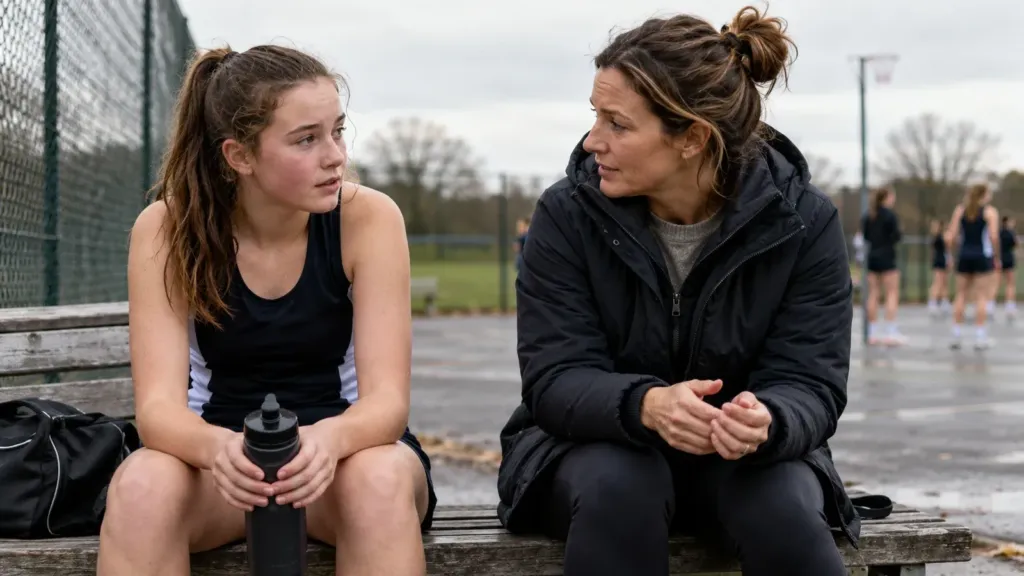




When your child loses confidence in sport, start by finding out what has changed rather than trying to talk them into feeling confident. Listen, work out whether the problem is a particular skill, competition pressure or the sporting environment, and agree on one small step they actually want to try.
You might notice they stop asking for the ball, avoid a shot they would normally take, go quiet before swimming races or say they are rubbish after a tournament. Those signs tell you something is happening. They don’t tell you why.
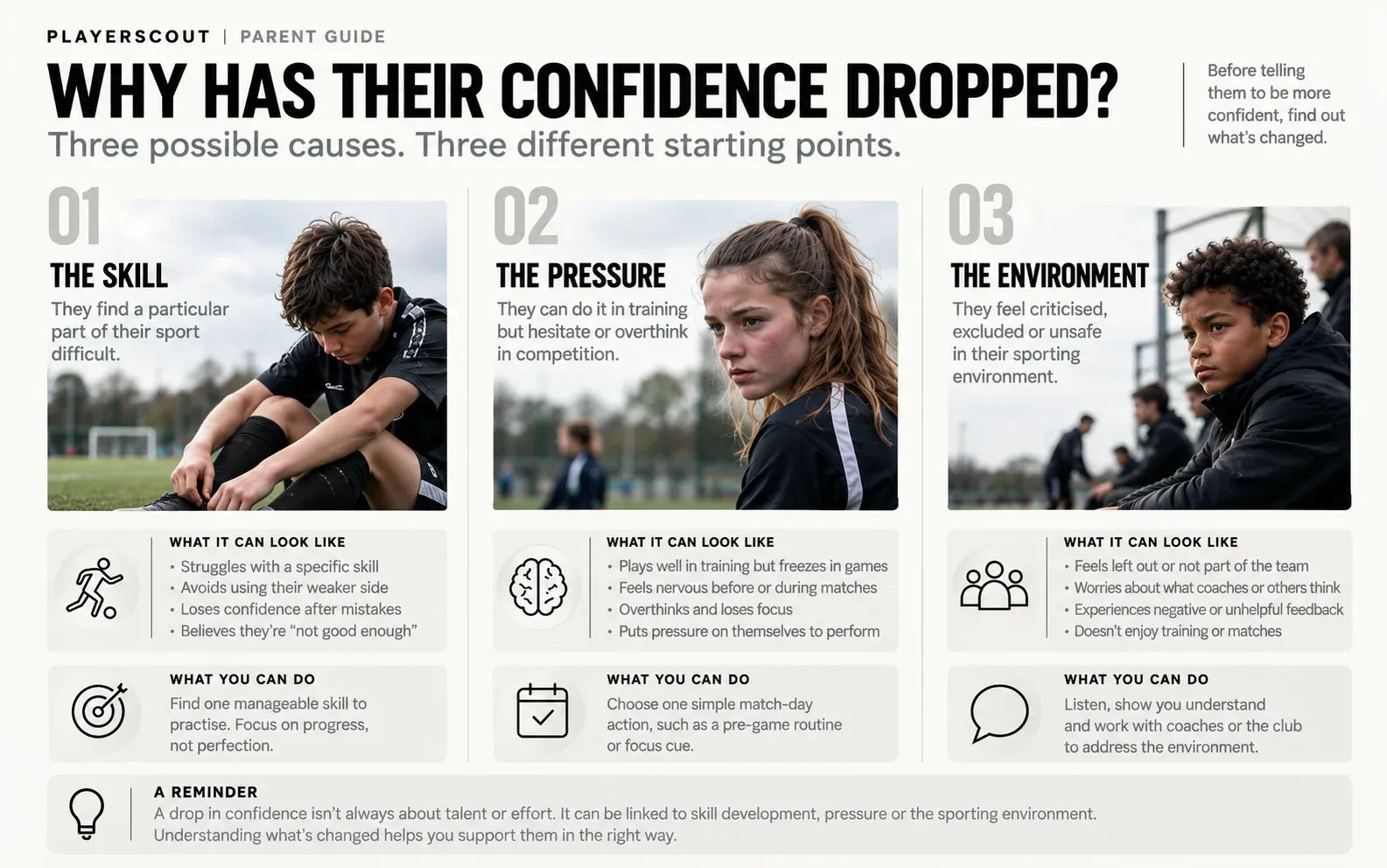
A useful starting point is to separate three possibilities. If your child struggles with a particular skill, ask the coach what suitable practice looks like. If the skill is there in training but disappears under pressure, help them choose one manageable competition action. If they feel unsafe, excluded or constantly criticised, look at the environment before prescribing more confidence work. These are questions to explore, not a diagnosis.
Your job as a parent isn’t to supply confidence on demand. It’s to help your child feel heard, find useful evidence of progress and stay involved in decisions about their sport.
First, find out where their confidence has gone
Ask, “When do you feel least confident?” That question gets you further than “Why aren’t you playing like yourself?”
A child who loves training but becomes hesitant in matches might be worried about making mistakes in front of people. A young tennis player might feel comfortable against familiar opponents but uncertain after moving up a level. A swimmer might trust their technique yet feel unsettled at a busy event. Another child may be exhausted, no longer enjoying the group or unsure what their coach expects.
These situations need different responses. More individual practice might help with a genuine skill gap. It won’t necessarily help a player who feels humiliated when they make an error.
Try three questions, separately and without turning them into an interrogation.
What is harder now than it was a few weeks ago?
Does this happen in training, competition or both?
Is there anything about the team, coach, group or environment that makes it harder to try?
You might not get a full answer straight away. Some children need time, and younger players may describe an event rather than a feeling. Listen for specific moments instead of demanding a label.
What to say when your child tells you they’re not good enough
Imagine your child gets into the car after a poor game and says, “I’m rubbish.” The temptation is to reply, “No, you’re brilliant!”
You mean it kindly. But if they don’t believe you, the conversation can turn into a debate about whether they’re any good.
Try: “It sounds like that was a tough one. What felt hardest today?” If they point to a particular moment, you can acknowledge it: “You didn’t get that pass right, and you’re upset about it. That doesn’t tell us everything about your ability.”
If they don’t want to talk, respect that. Say you can listen later. A child doesn’t owe you a detailed performance review because you drove them to the match.
This isn’t about banning reassurance. Children need warmth and encouragement. It’s about listening before giving your verdict. Sport England’s guidance for parents and carers puts listening to the child and asking how they want to be supported at the centre of a positive sporting experience.
Give them something more useful than constant praise
Confidence can become fragile when a child judges their whole ability from their latest result or from what adults say about it.
Specific feedback is more helpful than a stream of “You’re amazing.” You might say, “You made yourself available after that missed pass,” or “You stayed with your race plan even after a slow start.” Only say those things when they actually happened.
A systematic review published in January 2024 brought together 29 studies involving 9,185 young sport participants and 2,191 parents. It associated supportive parent relationships, appropriate involvement and a learning-focused climate with young people’s motivation. Most included studies were cross-sectional, and the review studied motivation rather than testing these exact confidence-building phrases. That distinction matters: useful guidance is not a proven script.
Help them notice evidence beyond scores, wins and selection. What can they do now that was difficult two months ago? Which decision was better, even if the outcome wasn’t? What are they learning to manage?
The aim isn’t to manufacture positives after every game. It is to give them a more accurate picture than the worst five minutes of their week.
Check the environment before asking them to be braver
If your child dreads a teammate’s reaction, a coach’s comments or being singled out, extra repetitions may miss the problem. Ask what happens immediately before they become hesitant: is it the task itself, who is watching, or how people respond?
Sometimes the issue isn’t inside the player. Look at the conditions around them, not just their thoughts.
Are mistakes treated as part of learning, or do children fear being embarrassed? Does the coach explain roles and expectations? Is your child getting suitable opportunities to practise what they are learning? Do they feel included in the group?
Sport England’s work on positive experiences emphasises enjoyment, confidence, competence and safe participation together. That’s a useful reminder that confidence isn’t only an individual mindset task.
If something seems wrong, have a calm, specific conversation with the coach. “She seems worried about trying the new skill in competition. How are you helping players practise that decision?” is a more useful opening than accusing the coach of ruining her confidence.
Not every difficult coaching moment is harmful. But humiliation, intimidation, discrimination or unsafe behaviour must not be excused as character-building. Raise welfare concerns through the club’s safeguarding or welfare route rather than asking a child to toughen up.
Choose one small challenge with your child
Once you understand the issue, ask your child to choose one action they would be willing to try. Don’t set a target that depends on winning, selection or a coach’s decision.
A basketball player who’s stopped driving towards the basket might choose to attack the space once when the right opportunity appears. A netball player could aim to make one clear call for the ball. A tennis player could decide to commit to a serve routine rather than judging the whole match by double faults.
Make it small enough to attempt and meaningful enough to learn from. If the child chooses an easier first step, that’s information worth respecting. You can build from there.
Afterwards, ask what they noticed. “What made that easier or harder?” often teaches you more than “Did you do it?”
If the problem is an in-game lapse after an error, our guide to recovering after a mistake in sport offers a player-facing starting point. If the bigger difficulty is worry before the event, read our guide to nerves before competition. Neither guide replaces a conversation about the environment.
Keep the car journey home separate from the coaching session
Keep the difference between a performance and a person clear. “That pass didn’t work” describes an event. “You’re a nervous player” turns it into an identity. Discuss what happened, when your child wants to, without making one moment a verdict on who they are.
Your child may already have heard feedback from the coach. Another analysis in the car, before they’ve taken their boots off, can feel like a second assessment.
Ask in advance what they would prefer after competition. Some children want to talk immediately. Others want a snack, music or a normal conversation about the rest of their day.
You can still discuss something important later. Pick one question, listen properly and avoid listing every mistake you noticed. If they ask for technical advice that you can’t reliably give, involve their coach rather than becoming an extra coach from the passenger seat.
The relationship matters more than extracting a lesson from every performance. Your child should know that the journey home won’t depend on whether they won.
A seven-day parent plan to try, without forcing progress
This is a conversation plan, not a seven-day confidence cure. Adapt the pace to your child’s age, preferences and training schedule.
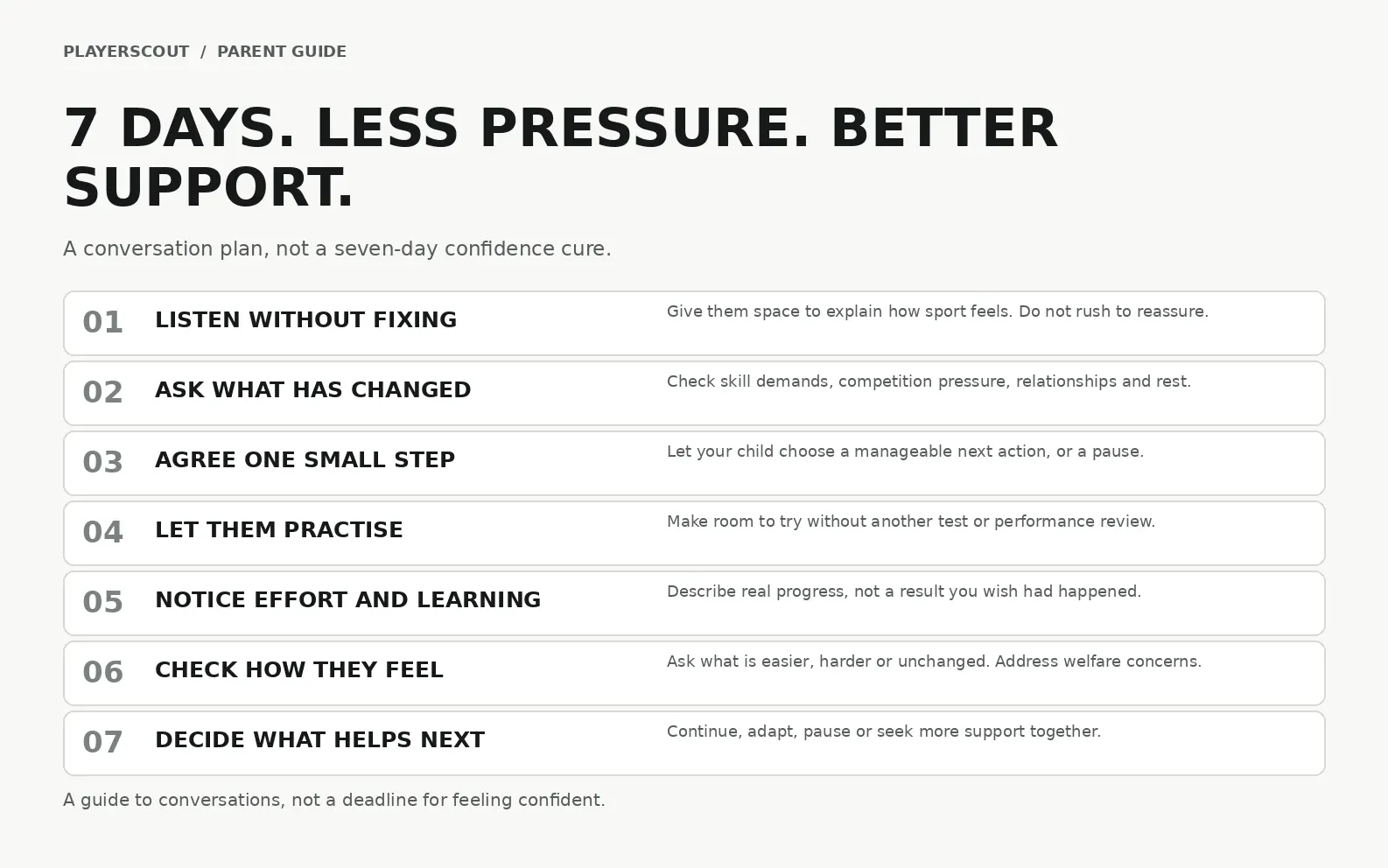
Day 1. Listen. Ask when sport has felt difficult lately. Don’t correct the answer.
Day 2. Check the context. Think about recent changes to team, level, role, expectations, rest or friendships.
Day 3. Agree one small step together. Ask your child to choose a manageable action, or to decide that a break or conversation comes first.
Day 4. Let them practise. Give them time and a suitable opportunity to try their chosen step without turning it into a test.
Day 5. Notice effort and learning. If something genuinely changed, describe it specifically. Leave room for enjoyment rather than another performance review.
Day 6. Check how they feel. Ask whether anything is easier, harder or unchanged. If the environment is part of the problem, speak to the coach or welfare lead as appropriate.
Day 7. Decide what helps next. Ask whether your child wants to continue the small step, change the environment, take a break or seek more support.
If they haven’t improved by day seven, the plan hasn’t failed. You have gathered information without turning their confidence into a deadline.
When to ask for more support
A difficult run of matches, disappointment about selection or temporary uncertainty doesn’t automatically mean a mental-health condition.
Take it more seriously if your child is persistently distressed, avoiding activities they used to enjoy, struggling with sleep or school, or becoming increasingly withdrawn. The NHS advises seeking professional help when anxiety is worsening, lasting or affecting everyday life. In the UK, a GP is a sensible starting point. Elsewhere, contact an appropriate qualified local health professional.
If the sporting environment feels unsafe, use the organisation’s safeguarding process. A mental-skills programme must never be presented as a substitute for clinical or safeguarding support.
Help them keep ownership of their sport
You don’t need to tell your child they will definitely become confident again by the next competition. You can help them understand what has changed, make space for disappointment and take a sensible next step.
If they’re ready for practical mental-skills work, let them look at the player-facing resources with you rather than making them a project to fix. PlayerScout’s Player Mindset Program is one optional structured learning route, not something every child needs.
The better question isn’t “How do I make my child confident?” It’s “What support will help my child keep learning, making choices and enjoying their sport while confidence is low?”
Was this helpful?
 9 min