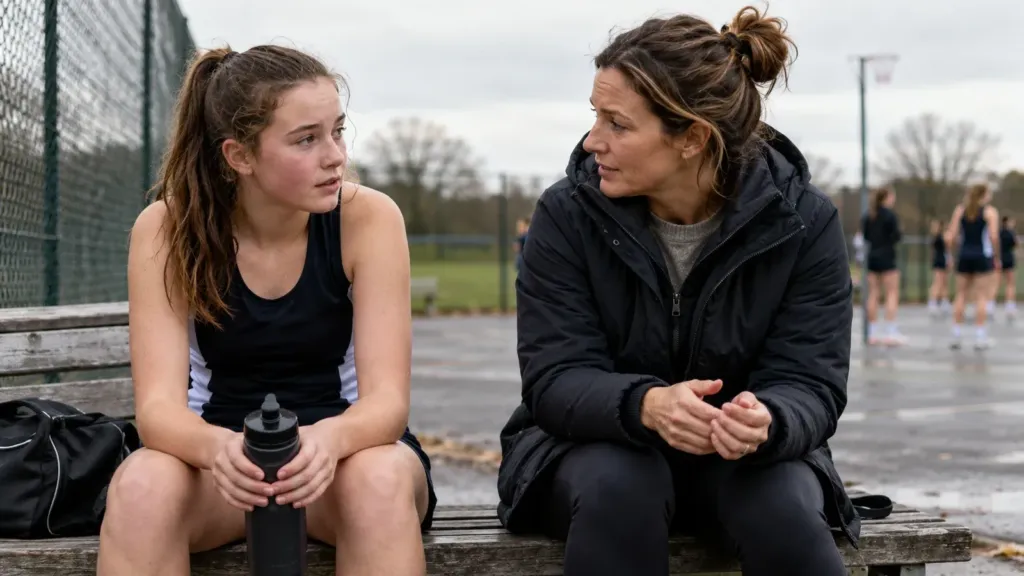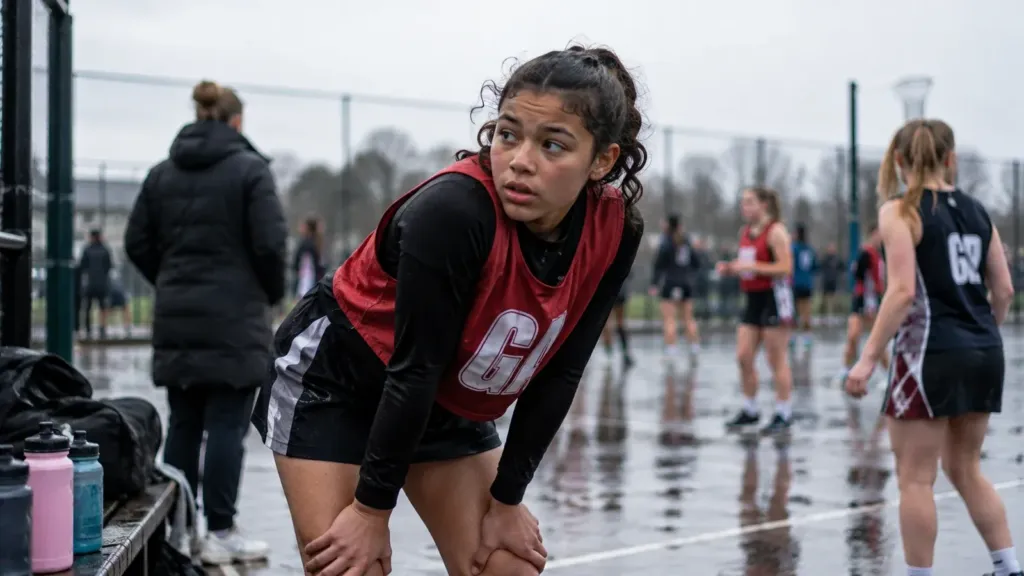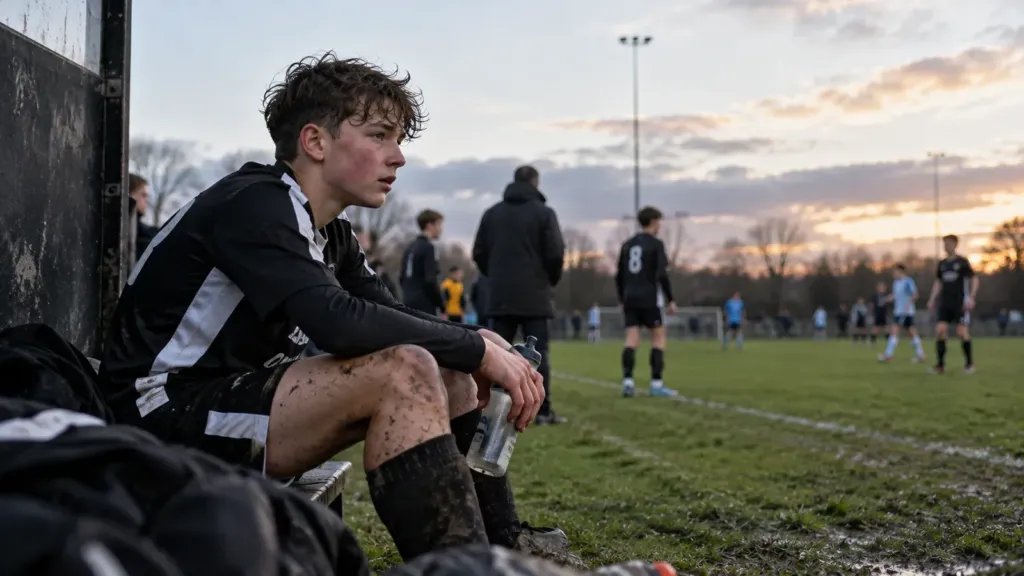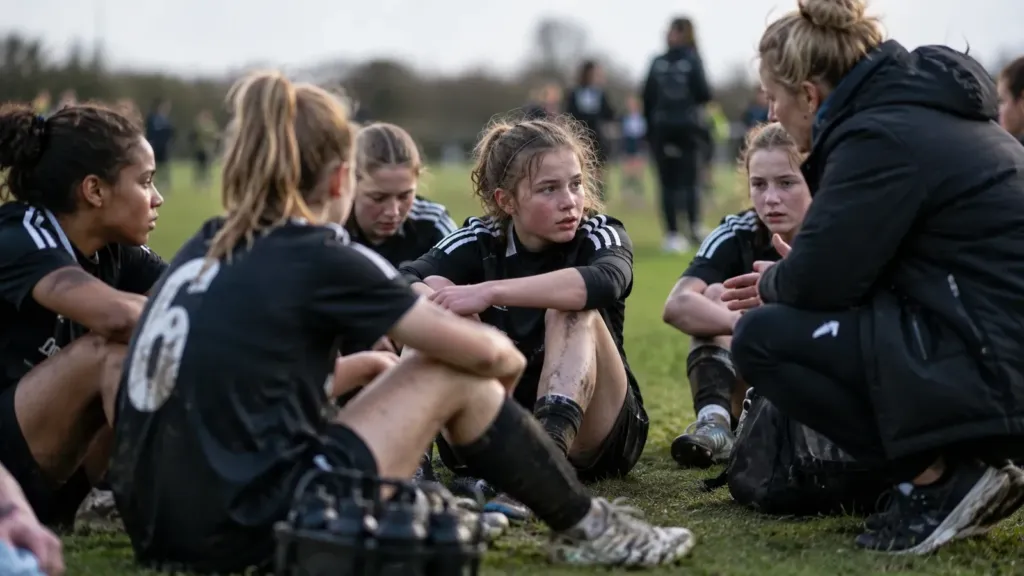




The player felt fine at breakfast.
Then they arrived at the venue.
Now their stomach feels different. They need the toilet again. Their hands feel cold. Their heart is beating harder and they suddenly have no appetite. They are looking at the opposition, thinking about the result and wondering why they feel so nervous when they were confident yesterday.
Nothing unusual has necessarily happened.
Competition has become real.
The mistake I would avoid is teaching a young player that good preparation should make all of those feelings disappear. That sets them up to become worried about being worried.
Nerves before competition are common. The more useful skill is learning what those feelings mean for the individual player, keeping them within a manageable range and knowing what to do next.
Nerves happen in the body as well as the mind
When players describe nerves, they often talk about thoughts: What if I mess up? What if I lose? What if I disappoint everyone?
But competition anxiety also has a physical side.
The heart might beat faster. Breathing changes. The stomach feels unsettled. Muscles feel tense. Some players sweat more, feel shaky or need the toilet repeatedly. Appetite can disappear even though they know they need to eat.
Sport psychology commonly distinguishes cognitive anxiety, involving worry and negative thoughts, from somatic anxiety, involving physical sensations. Research has also shown that the relationship between competitive anxiety and performance is not simple enough to say that more nerves always mean worse performance.
That distinction helps because a player who understands their normal physical response is less likely to treat every sensation as evidence that something is wrong.
A racing heart before an important competition does not automatically mean the player is mentally unprepared.
The meaning a player gives the nerves matters
Two players notice the same physical sensation.
One thinks, “I’m nervous. I’m going to play badly.”
The other recognises, “My body always feels like this before I compete.”
The sensation has not disappeared, but its meaning has changed.
Research on anxiety interpretation in sport has found that performers differ not only in how much anxiety they experience, but also in whether they interpret those symptoms as helpful or harmful to performance. Work comparing more and less successful performers has reported that interpretation can distinguish athletes even when anxiety intensity itself does not.
I would be careful about turning that into “nerves are good”.
Sometimes nerves feel awful. Sometimes they interfere with eating, sleeping, concentration or decision-making.
The useful shift is smaller.
Feeling nervous does not tell you how you are about to perform.Grantley Baugh, Founder of PlayerScout
Stop checking whether you feel ready
Players sometimes spend the final hour before competition repeatedly testing themselves.
Do I feel confident yet?
Am I calm enough?
Why am I still nervous?
Do my legs feel good?
Am I focused?
Every check keeps attention on the internal state the player is trying to change.
I would rather the player have a routine that keeps moving whether they feel brilliant, average or nervous.
Get changed. Eat what was planned. Fill the bottle. Warm up. Listen to the information you need. Use the same preparation cues you have practised.
You are not waiting for the correct feeling before you begin.
That matters because confidence and readiness do not always arrive as a strong emotion. A player might feel nervous right until the start and still perform well.
Do not build the whole day around the competition
An evening event creates a particular problem.
The player wakes up thinking about it.
By 10am, they are imagining the start.
At lunch, they are checking how nervous they feel.
By 3pm, they have mentally competed several times already.
For some players, too much empty time before an event gives worry more room.
I would not try to fill every minute as a distraction. I would keep the earlier part of the day reasonably normal where possible.
Eat.
Go to school if that is the normal schedule.
Rest.
Do something unrelated to sport.
Prepare equipment at a sensible time.
Then let the competition routine begin when it genuinely needs to begin.
The exact timing will vary between sports and players, but there is rarely much benefit in starting the psychological build-up eight hours before the physical warm-up.
Preparation reduces decisions. It does not guarantee calm.
A good pre-competition routine is useful partly because it removes unnecessary decisions.
The player already knows what they are taking.
They know roughly when they will eat.
Their equipment is ready.
They know when they need to leave.
They know what the warm-up normally looks like.
They might have one or two performance cues they want to carry into the event.
None of this guarantees they will feel calm.
That is fine.
The routine has still done its job by reducing avoidable uncertainty.
This is also where the physical and mental sides of preparation meet. A nervous player who has no idea when they are eating, cannot find part of their kit and is leaving late now has several real problems on top of the nerves.
Preparation will not remove pressure from an important competition, but it does not need to add more either.
Breathing is useful when you understand what you are asking it to do
Breathing exercises are one of the first things players are given for nerves.
There is a reason for that. Slow breathing practices have been studied for their effects on physiological arousal, stress and anxiety, and systematic reviews report potentially useful effects, although methods and populations vary considerably.
I would use breathing as a way of regulating the player rather than as a test they have to pass.
If a few slower, controlled breaths help settle the rush of the moment, good.
If the player still feels nervous afterwards, the technique has not necessarily failed.
The problem starts when the player thinks, “I did my breathing and I still feel nervous, so something must be wrong.”
Nothing says a breathing exercise has to remove every sign of arousal before the player is ready to compete.
Use it to create a little more control, then continue with the preparation.
The player does not always need to calm down
Some players are too activated before competition.
They rush.
They talk constantly.
They cannot settle.
They burn energy in the warm-up.
For them, bringing arousal down might help.
Other players go the other way. They become quiet, flat or sleepy and feel as though they cannot switch on.
Telling both players to “calm down” makes little sense.
One of the older ideas in sport psychology is that performance is related to an individual’s preferred or optimal zone of arousal rather than one universal ideal level. The exact theories and measurement approaches have been debated for decades, but the practical point survives: players differ.
I would want a player to learn their own pattern.
How do you normally feel before your better performances?
Not perfectly calm. Not wildly confident. Just ready enough to compete.
That gives you a more useful target than trying to feel the way somebody else looks.
Be careful with what happens in the final few minutes
The last part before competition is where adults sometimes add too much.
A parent gives a final speech in the car.
A coach adds three tactical instructions.
Someone reminds the player how important the event is.
Another person tells them not to be nervous.
The player already knows it matters.
I would keep the final information useful and limited.
If there is something tactically important, say it clearly. If the player has one established cue, return to it. If nothing needs adding, there is no requirement to fill the silence.
A nervous player does not always need more words.
Nerves often affect eating, so plan for that before competition day
Some players can eat normally before competing.
Others lose their appetite as the event gets closer.
Trying to solve this for the first time on the morning of an important competition is difficult.
Our guide to what a young player should eat before competition covers the nutrition side in more detail, including what to do when nerves affect appetite.
From a mindset point of view, the useful lesson is to learn the pattern early.
If solid food becomes difficult close to competition, work out which familiar foods are easier to manage. If the player eats better earlier, build more of the fuelling around that window.
Do not turn eating into another battle immediately before they compete.
Looking at the opposition can change the whole state
A player arrives feeling reasonably good.
Then they see the other team warming up.
Or the next opponent is hitting harder than expected.
Or another competitor looks bigger, faster or more experienced.
Suddenly the nerves increase.
What changed?
Not the player’s ability.
Their attention moved towards information they started using to predict the result.
Some information about an opponent is useful. Coaches and players need to observe what is relevant to performance.
But watching somebody warm up and building an entire story about how good they are is different.
The player still has the same job they had before they saw them.
If watching opponents repeatedly sends a player into comparison and worry, bring attention back to their own preparation until there is something useful to observe.
Parents do not need to convince a nervous player that they should not be nervous
A player says, “I’m really nervous.”
The immediate response is often, “Don’t be nervous. You’ll be fine.”
The parent is trying to reassure them.
But the player is nervous.
Telling them not to be can make the feeling seem like another problem.
A calmer response might acknowledge it without making it bigger.
“You normally feel this before important competitions.”
“You’ve got your routine.”
“You don’t need to know how today is going to go yet.”
Then leave some space.
You do not need a motivational speech every time a player feels pressure.
Sometimes the most useful thing an adult can communicate is that nerves are not an emergency.
Once competition starts, the problem changes
Before competition, the player has time to prepare.
Once it begins, repeatedly checking whether they are nervous becomes less useful.
Now attention needs to move towards the event.
Where is the space?
What is the opponent doing?
What does the player need to see?
What is the next decision?
If thoughts about the result or technique begin taking over during competition, our guide on how to stop overthinking during competition deals with that problem in more depth.
If the player makes an error and the nerves spike again, how to recover quickly after a mistake covers the next part.
These are related skills, but they happen at different moments.
Before competition, prepare.
During competition, compete.
Afterwards, review.
When pre-competition nerves need more attention
Normal competition nerves and a more serious anxiety problem are not the same thing.
I would pay closer attention if anxiety is regularly stopping a young player from taking part, causing significant distress, affecting sleep or daily life, leading to repeated physical symptoms that need assessment, or spreading well beyond sporting situations.
The same applies if a player becomes increasingly fearful of training or competition rather than simply nervous before important events.
At that point, the aim should not be to keep adding performance tricks.
Parents should speak with an appropriate health professional, particularly where anxiety is persistent, worsening or interfering with normal life.
Sport psychology techniques have a place.
They should not be used to explain away a young person’s wider mental health.
Build a routine that still works when you are nervous
I would judge a pre-competition routine by a simple question.
Does it still work on the days when the player does not feel great?
If the whole routine depends on feeling confident, calm and positive, it is fragile.
A better routine gives the player a familiar path into competition even when their stomach feels strange, their heart is beating harder and their mind is throwing up doubts.
They eat what they know works. They arrive with enough time. They prepare their equipment. They warm up. They use the cues they have practised and gradually move their attention towards the competition.
The nerves might come with them.
They do not have to drive.
Was this helpful?
 9 min