

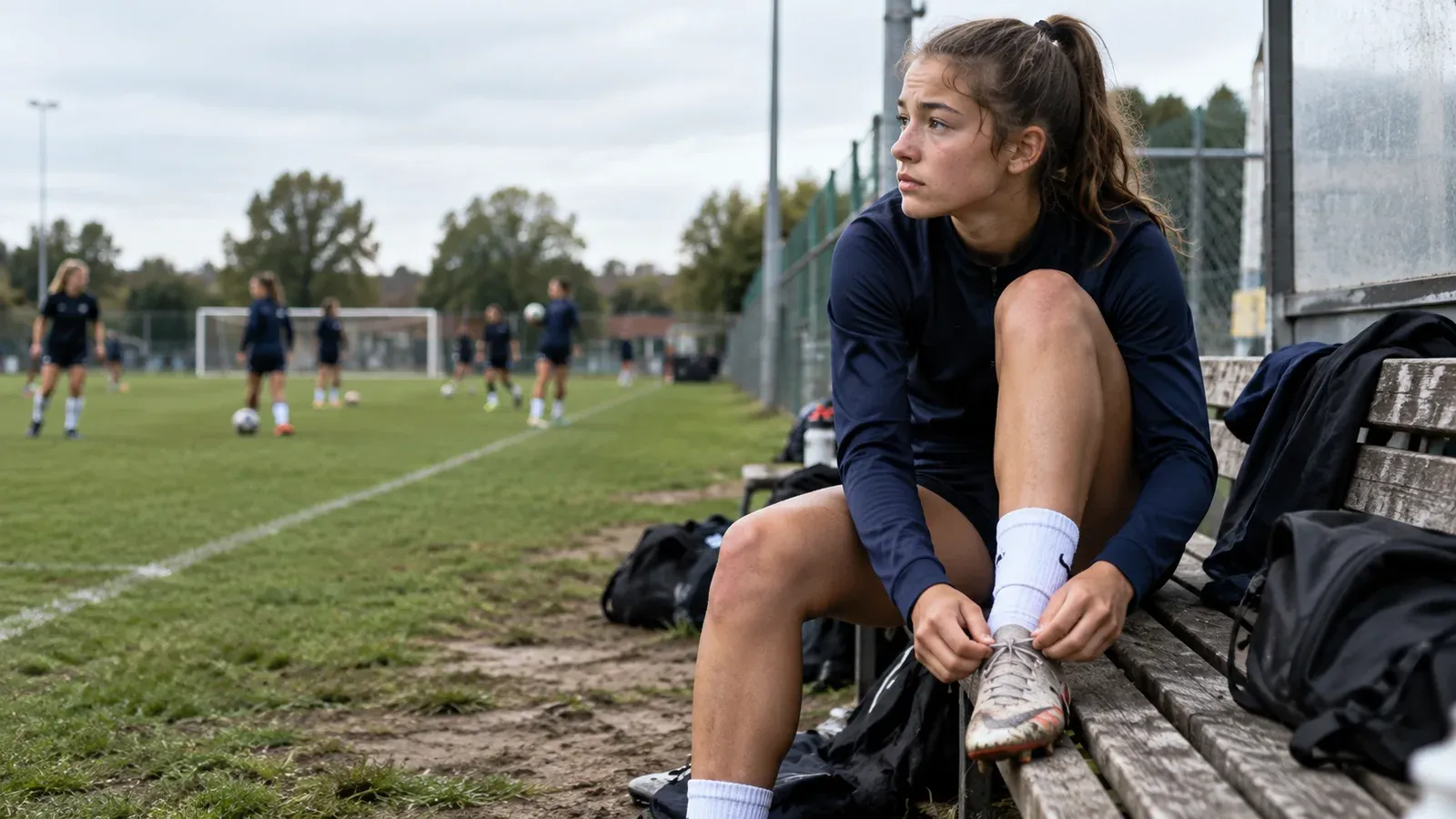

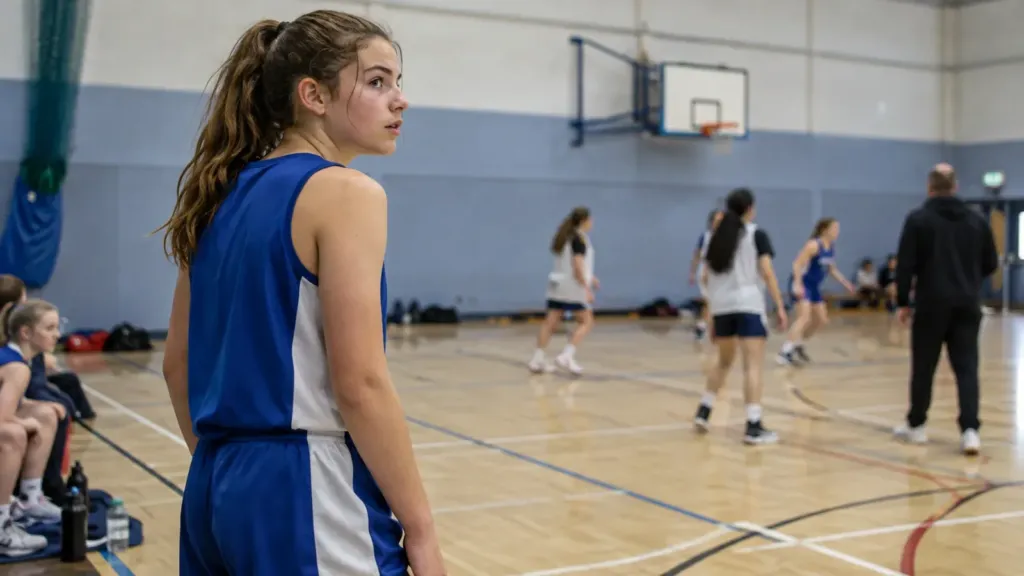
You’ve warmed up, listened to the team talk and checked your kit. Now you’re waiting to start. What should you actually do with your thoughts?
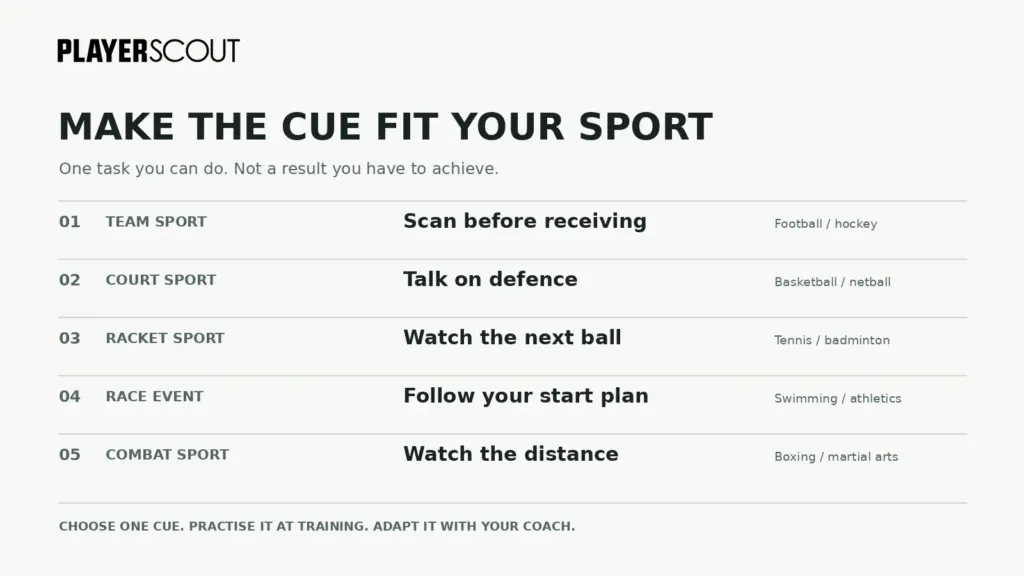
Try this five-minute routine: notice how you feel, breathe comfortably, choose your first job, rehearse a response to a difficult opening, then get ready to act. It gives your attention somewhere useful to go. It does not promise to remove nerves, produce confidence or improve every performance.
Practise it at training first. Use it around your physical warm-up and your coach’s instructions, never instead of them. Each minute is an approximate guide, not a scientifically proven duration.
Your five-minute pre-game routine
Minute 1: Notice, without trying to fix everything
Ask yourself, “What am I feeling, and what am I thinking about?” You might be nervous about the opposition, excited about starting or frustrated by a previous game. Name it briefly: “I’m nervous about making an early mistake.”
You do not need to argue with the feeling. The point is to recognise when your mind is occupied by a result you cannot control. If this step makes you dwell on your worries, shorten it and move on.
Minute 2: Breathe comfortably
Take a few unforced breaths. Let your shoulders soften if they feel tense. Keep your eyes open and stay aware of the warm-up or instructions around you.
There is no need to hold your breath, follow a complicated count or force yourself to feel calm. If focusing on breathing makes you uncomfortable or dizzy, stop and breathe normally. You can skip this step altogether.
Minute 3: Choose one first job
Pick an action you can actually do in the opening moments. A football defender could choose “check my shoulder before receiving”. A netball player might choose “show early for the pass”. A tennis player might choose “watch the ball and recover my position”.
Compare those with “play brilliantly”, “win” or “don’t mess up”. The first set tells you what to do. The second set asks you to control an outcome.
Choose just one cue that fits your role and your coach’s plan. A long list of technical corrections is not a useful pre-game routine.
Minute 4: Rehearse a realistic opening, including a mistake
Think through your first likely situation. Then add one ordinary complication.
A basketball player might picture receiving the ball, making a rushed pass and immediately getting back into defence. A tennis player might picture losing the first point and preparing for the next serve. A hockey player might picture a heavy first touch and recovering their position.
Ask yourself, “If that happens, what is my next useful action?” You are not trying to predict the match. You are preparing a response so an imperfect start does not become a reason to abandon your plan.
If visualising is difficult, describe the situation and response in words instead.
Minute 5: Stop preparing and start responding
Say your cue once, check where you need to be and listen to the coach or official. When play begins, pay attention to the real situation in front of you.
Preparation needs an ending. You do not need to keep checking whether you feel confident enough. Your job is to notice what is happening and make the next decision.
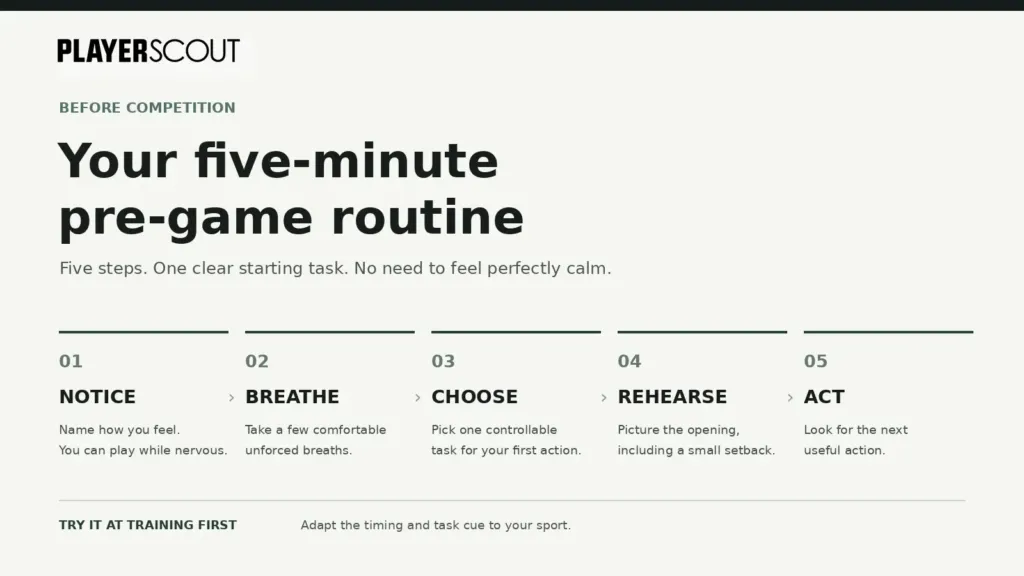
Pick a cue that matches your sport and role
The five steps are flexible. The first-job cue should change with the demands of your sport, position and event.
- Football or hockey: “Scan before receiving” rather than “Don’t give it away”.
- Basketball or netball: “Show early for the ball” rather than “Dominate the first quarter”.
- Tennis or badminton: “Watch the ball and get ready” rather than “Win the first point”.
- Swimming or athletics: “Follow my start and race plan” rather than “Beat my best time”.
- Combat sports: “Maintain the agreed distance and stance” rather than “Don’t get caught”.
These are examples, not universal tactical or technical instructions. Your coach’s guidance and your sport’s safety procedures take priority. A useful cue is short, controllable and connected to what you are likely to face first.
Make your own pre-game routine card
Write these five answers in your phone notes or on a card. Fill them in at training, not for the first time in a high-pressure match.
- NOTICE: Right now I feel __________. My mind keeps going to __________.
- BREATHE: I’ll take a few comfortable breaths, or __________ if breathing exercises do not suit me.
- CHOOSE: My first job is __________.
- REHEARSE: If __________ happens, my next useful action will be __________.
- ACT: When play begins, I’ll pay attention to __________.
Football example: “I’m nervous about my first touch. I’ll scan before receiving. If I lose the ball, I’ll recover my position and show again.”
Tennis example: “I’m excited and rushing. I’ll watch the ball. If I lose the opening point, I’ll prepare for the next serve instead of replaying the mistake.”
Swimming example: “I’m thinking about my time. I’ll follow the start procedure and race plan. Afterwards, I’ll review the swim rather than trying to analyse it during the race.”
After training, cross out anything that distracted you. Keep what was useful. This is your routine, not a script you must perform perfectly.
What if you only have 30 seconds?
Sometimes the team talk runs late or your event is called early. Do not turn the routine into another thing to worry about.
Use the short version: one comfortable breath, one first-job cue, then act. If breathing does not suit you, go straight to the cue. The event schedule, physical warm-up and coach’s instructions always come first.
There is no evidence that five minutes is a magic number. A routine you can adapt is more practical than one that only works when everything goes to plan.
How parents can help without taking over
Help your child build the routine away from match-day pressure. Before training, ask, “What’s one job you want to focus on first?” Let them choose.
Before a match, ask whether they want a reminder. Some players appreciate a quiet prompt; others prefer silence. Avoid adding last-minute tactical instructions, score predictions or warnings about the opposition. Those can compete with the simple cue the player has chosen.
Afterwards, do not judge the routine by the score. A player can follow their first-job cue and still lose. If they want to talk, ask, “Was any part of your preparation useful?” That helps them improve the routine without turning it into another test.
Test it at training before relying on it
Try the routine before two or three training sessions. Afterwards, note what you remembered, what distracted you and what you would change.
You might shorten the noticing step, use movement instead of a breathing exercise or choose a different cue when your role changes. If your coach needs you during the routine, stop and listen. Preparation should help you participate, not pull you away from your team.
If competition is causing persistent distress, avoidance, panic or sleep problems, a pre-game routine is not treatment. Speak with a qualified health professional.
What the research supports
Pre-performance routines are established in sport psychology, particularly immediately before a specific skill such as a serve, putt or free throw. The Association for Applied Sport Psychology describes routines that combine behaviour and mental preparation.
A systematic review and meta-analysis by Rupprecht, Tran and Gröpel found performance benefits in the studies reviewed. But evidence about preparing for a particular skill is not proof that this exact five-minute sequence improves an entire match, especially for young players across different sports.
These five steps are a PlayerScout practical framework, not a clinically tested intervention. Use them as a starting point and adapt them to what helps you.
For broader guidance, see PlayerScout’s article on dealing with nerves before competition. For families wanting a structured approach beyond this free routine, explore the Player Mindset Program, an eight-week programme with short lessons and practical mental-skills exercises.
Was this helpful?
 10 min