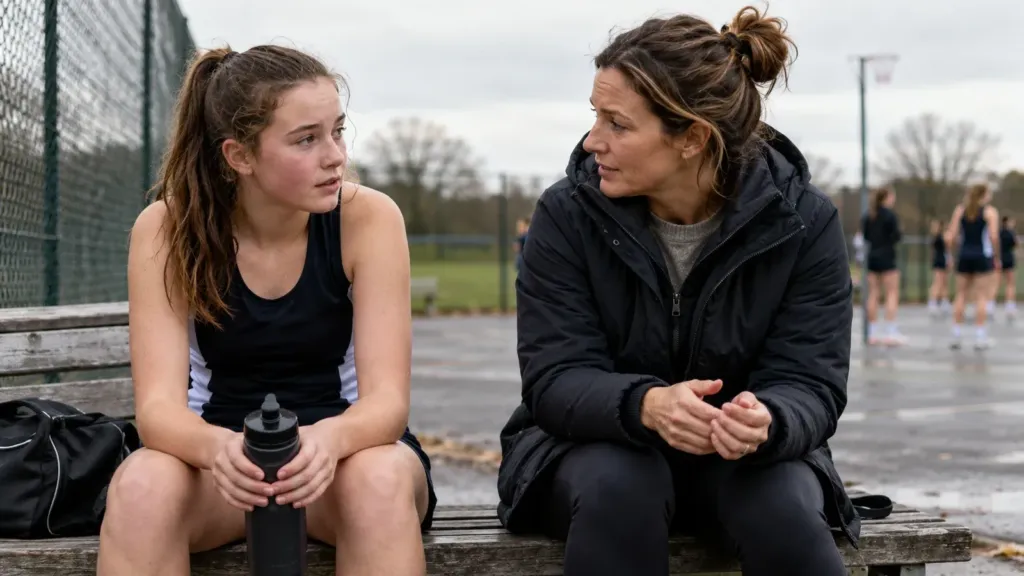





You can care deeply about your child’s sport and still add pressure without meaning to. It might be the instruction shouted from the sideline, the question about why they were substituted, or the detailed review on the drive home. None of these automatically makes you a bad sports parent. What matters is how your child experiences your involvement, and whether you are willing to adjust it.
The useful question is not simply “Am I supportive?” It is “Does my child feel supported, and what would they like me to do differently?” Those answers can be different. In a study of 108 parent-child pairs in youth ice hockey, parents generally reported less pressure and more support than their children perceived. A separate study of youth-sport families also found that family members’ reports did not always agree. Neither study tells us how any individual child feels. They give parents a reason to ask rather than assume. These studies compare how parents and children report involvement in youth sport. They cannot tell us what every family experiences.
What does parental pressure look like in youth sport?
Pressure is not limited to shouting or demanding a win. It can come from repeated attention to selection, statistics, mistakes, playing time or future opportunities. A child may begin to feel that every session is an assessment. Even praise can feel loaded if it arrives mainly after an excellent performance.
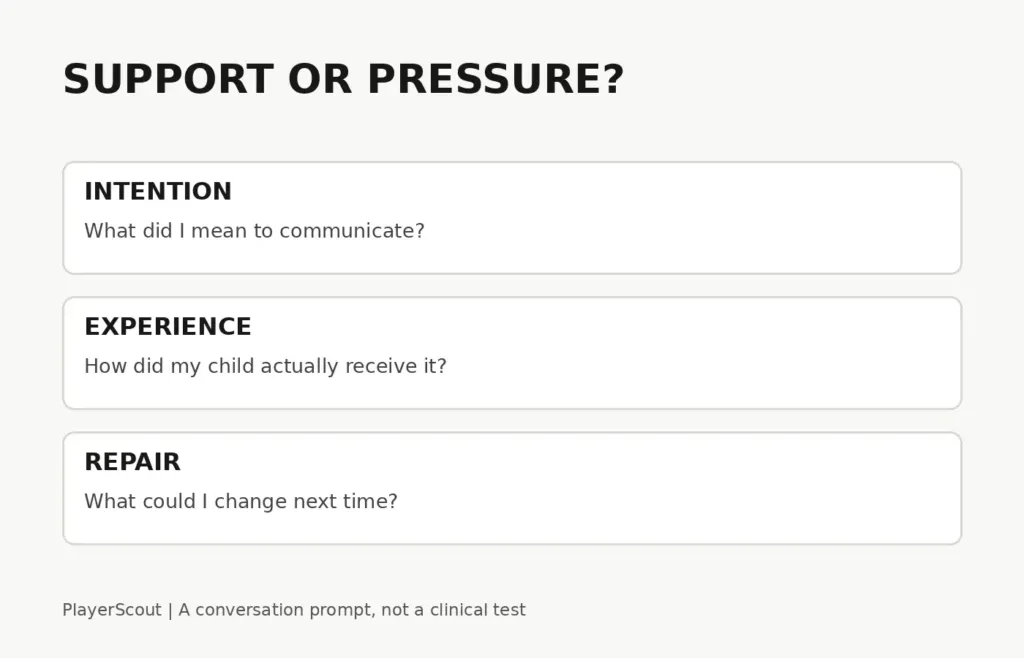
There is an important distinction: support and pressure are not simply opposite ends of one scale. A parent can provide lifts, pay fees and show up every weekend while also making a player anxious about the result. The aim is not to become less interested. It is to make your involvement feel safe and useful to your child. A 2012 narrative review of 23 studies describes support and pressure as related but distinct parts of family involvement.
Compare two questions after a match. “Did you enjoy playing?” invites your child to tell you about their experience. “Why didn’t you take that chance?” asks them to account for an error. The second question is not always harmful, but the timing and tone matter. A child who has already spent an hour trying to perform may not want another evaluation.
Parents also face pressure themselves. Travel, costs, schedules and expectations from clubs can make sport feel like a major family investment. Research with 1,229 US parents found that perceived pressure from club coaches was associated with greater financial spending. That is an association, not proof that a particular coach caused it. It is a reminder that pressure can come from the wider sport environment.
Five signs your child may be feeling more pressure than support
Look for patterns, not a single bad day. Your child might:
• Ask repeatedly whether you were disappointed after a mistake.
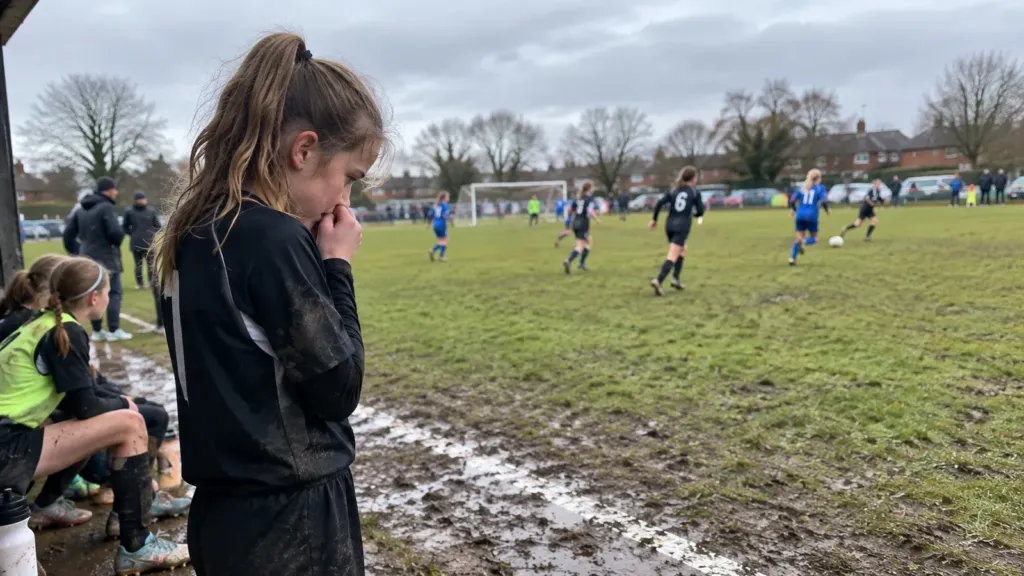
• Watch your reaction immediately after being substituted or losing.
• Avoid talking about their sport because every conversation becomes a review.
• Say they are scared of letting you down, rather than only disappointed about the result.
• Seem less willing to try difficult skills when you are watching.
These signs do not prove that parental pressure is the cause. Coaching, friendships, selection worries, school stress and normal developmental changes can all contribute. Ask what is happening before drawing conclusions.
A useful follow-up is: “Does this happen when I’m watching, when the coach is watching, or even when nobody is there?” It is not a diagnostic test. It simply stops you jumping straight to the wrong explanation. A player worried about being dropped may need a conversation about the club’s selection process, not a parent promising to clap less.
The difference between your intention and their experience
A parent might shout “Get stuck in!” to show enthusiasm. One child hears encouragement; another hears criticism. A parent might pay for extra training to provide an opportunity, while the child feels obliged to make that investment worthwhile. You cannot work out the meaning from your intention alone.
Try asking, at a calm moment: “When I watch you play, what do I do that helps? Is there anything I do that makes it harder?” Listen without correcting their answer. You can disagree later about a detail without arguing about how they felt.
If they say “You shout too much”, resist asking them to prove it or turning the conversation into a debate about your intentions. Try “Which moments do you notice it most?” Then agree one observable change: no instructions during play, no comments about officials, or no technical feedback until they request it. Ask again after two or three sessions. That is more useful than asking whether you are a good parent.
What to say before, during and after a game
Before the game
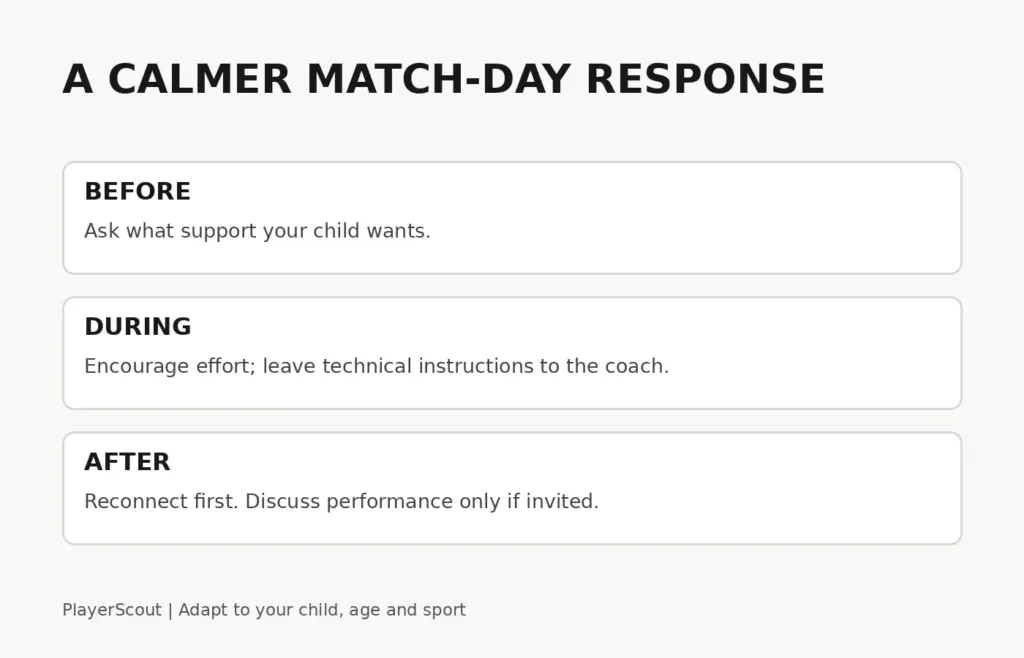
Ask what support they want. “Would you rather I cheer, stay quiet, or just be there?” Some children like visible encouragement. Others want a parent to watch without commenting. If they have a coach, let the coach handle technical instructions.
During the game
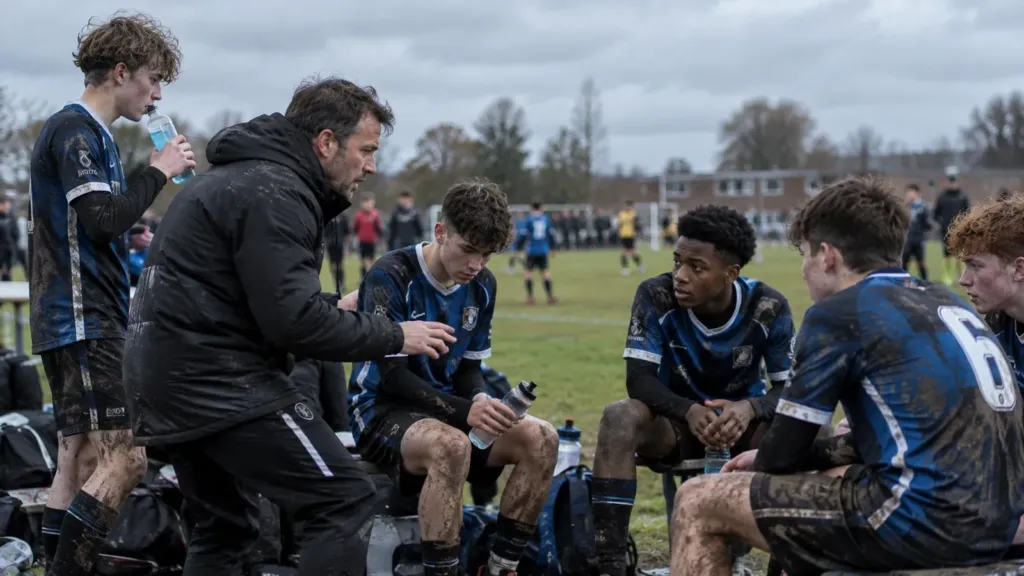
Support the team without turning the sideline into a second coaching area. Avoid calling out mistakes, questioning officials or instructing your child through every decision. A qualitative study of 57 children reported a preference for supportive parental presence rather than parents acting as demanding coaches or hostile spectators. That is a small qualitative sample, not a rule that every child wants silence. Ask your own child. The study explored children’s preferences for parental behaviour at youth sport events.
Imagine a player losing possession. A parent shouts “Pass earlier!” while the coach calls for the player to recover their position. The player now has two instructions competing for attention at precisely the moment they need to act. You can be engaged without adding another voice.
After the game
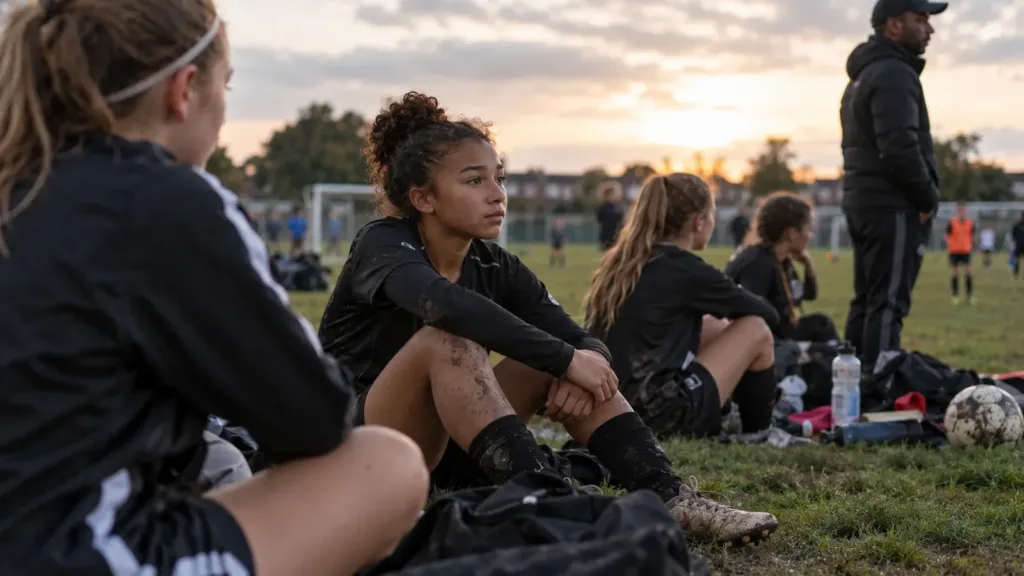
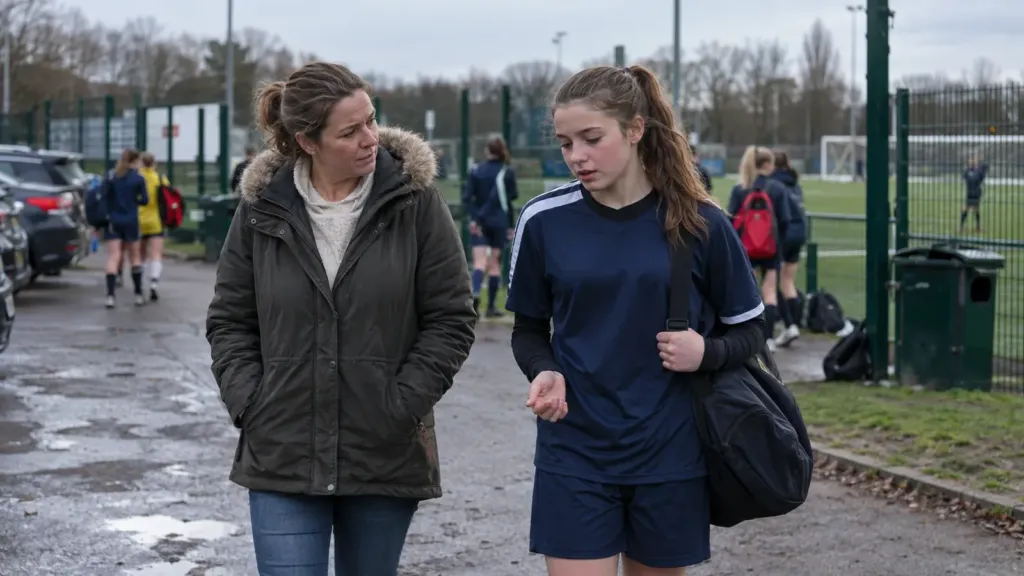
Start with the relationship. “Good to see you.” “Do you want to talk about it or leave it for now?” If they are upset, you do not have to solve the match in the car. Food, water, rest and a normal conversation may be more useful in that moment. If they ask for feedback, keep it specific and manageable.
Try a simple permission rule: no performance analysis unless the player asks for it or agrees to it. If they do want to talk, ask “What did you notice?” before giving your verdict. This is especially important after a difficult selection decision. They may want you to listen, help them contact the coach, or leave the subject alone. Those are three different needs.
How to repair it when you have added pressure
You do not need a dramatic speech. Start with a specific apology, ask what your child would prefer and follow through. A promise to change means little if the same behaviour returns the next weekend. Avoid adding “but I only do it because I care”. That turns the apology back into a defence of your intentions.
You could say: “I realised I kept telling you what to do from the sideline. I thought I was helping, but I can see it might have made things harder. I’m sorry. What would you prefer next time?” Then follow through. If your child asks for fewer comments, practise being quieter for several matches, not just one.
If the pressure is coming from a club or coach, avoid placing the whole problem on your child. Ask about expectations, workload and how feedback is delivered. Speak privately with your child about what they are experiencing, and raise concerns with the appropriate club contact rather than asking them to manage an adult disagreement. Where behaviour becomes humiliating, threatening or unsafe, use the club’s safeguarding process rather than treating it as a performance issue.
A seven-day reset for sports parents
Day 1: Ask your child which parts of your support they like and dislike.
Day 2: Agree on one sideline rule you can actually follow.
Day 3: Notice how often you mention outcomes, selection or mistakes.
Day 4: Let your child lead one conversation about sport, including whether to have it.
Day 5: Recognise something specific without adding a correction. “I noticed you encouraged your teammate after that mistake” is different from “Great effort, but you need to be quicker.”
Day 6: Spend time together that has nothing to do with sport.
Day 7: Ask whether anything felt different. Let your child say what helped, what did not, and whether there is one change worth keeping.
If your child does not want to discuss sport, do not turn the exercise into another obligation. You can still change your own behaviour.
This is a practical reflection exercise, not a validated seven-day treatment. The aim is to make support more responsive to your child, not to score your parenting.
When should you get extra support?
If your child is persistently distressed, losing sleep, withdrawing from activities they usually enjoy or expressing intense fear about participation, speak with an appropriately qualified health professional. If you are unsure where to start, your GP can help you discuss appropriate support. If they describe bullying, threats or abuse, follow safeguarding procedures promptly. Mental skills education is not a substitute for clinical care or safeguarding action.
Supporting a young player without taking over
Your child needs room to make decisions, make mistakes and develop their own relationship with sport. You can still be involved. Help them get to training, ask what they enjoy, take concerns seriously and show that your relationship does not depend on the result.
The practical test is whether your child has more say in how you support them, and whether your actions match what you agreed. For some families that means quieter sidelines. For others it means attending more often, asking fewer questions about results or being willing to challenge unsafe club behaviour. The right change depends on what is happening, not on a universal script.
If they want to practise mental skills such as refocusing after mistakes or preparing for competition, the Player Mindset Program provides structured education. It is optional, and it should never be presented as a fix for unsafe coaching or significant psychological distress.
Was this helpful?
 9 min