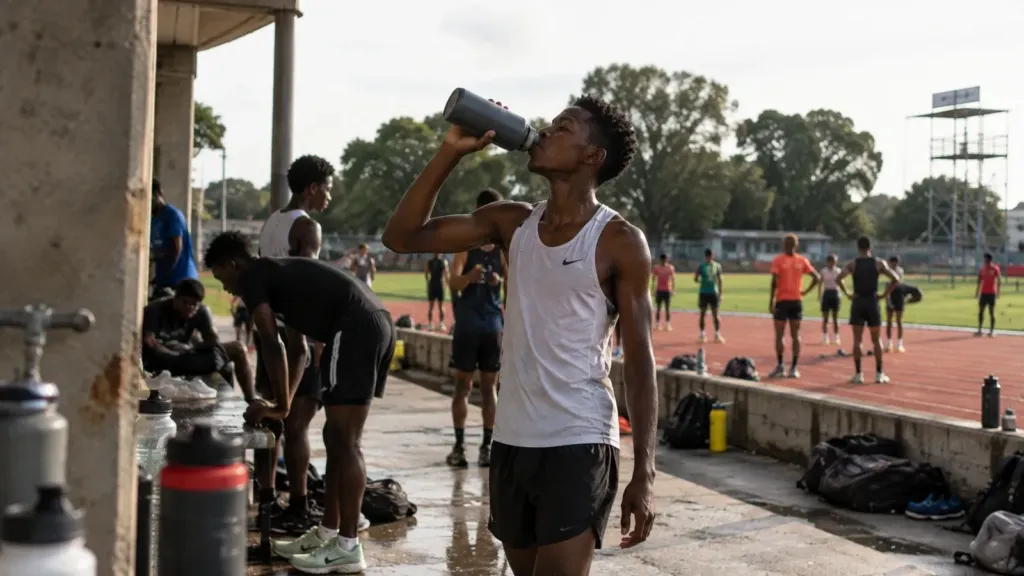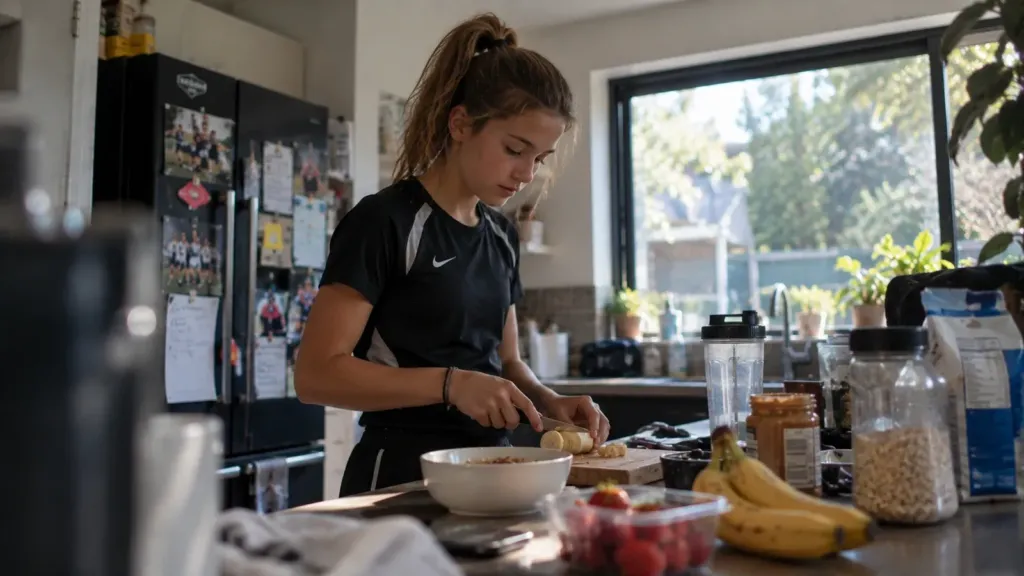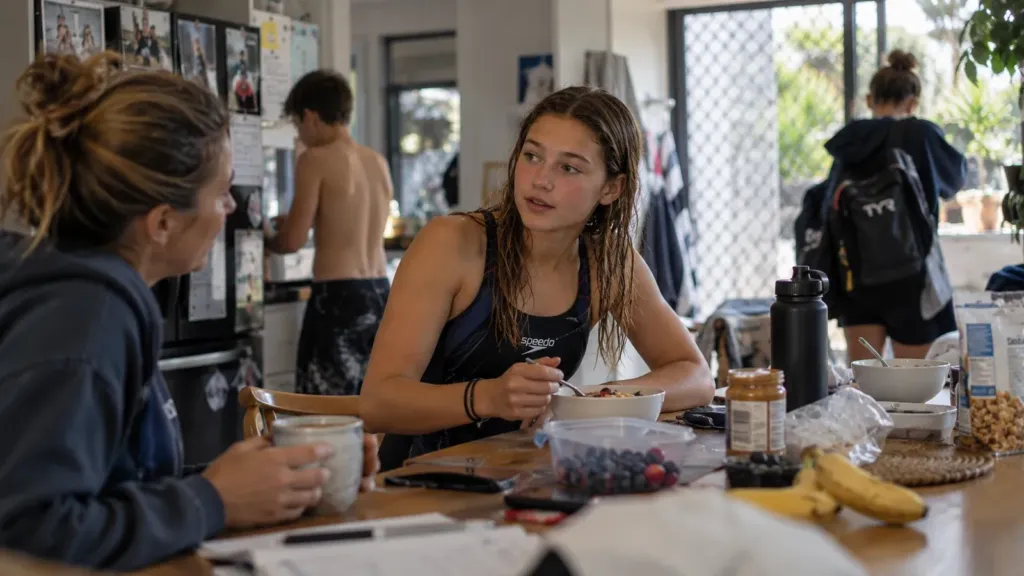




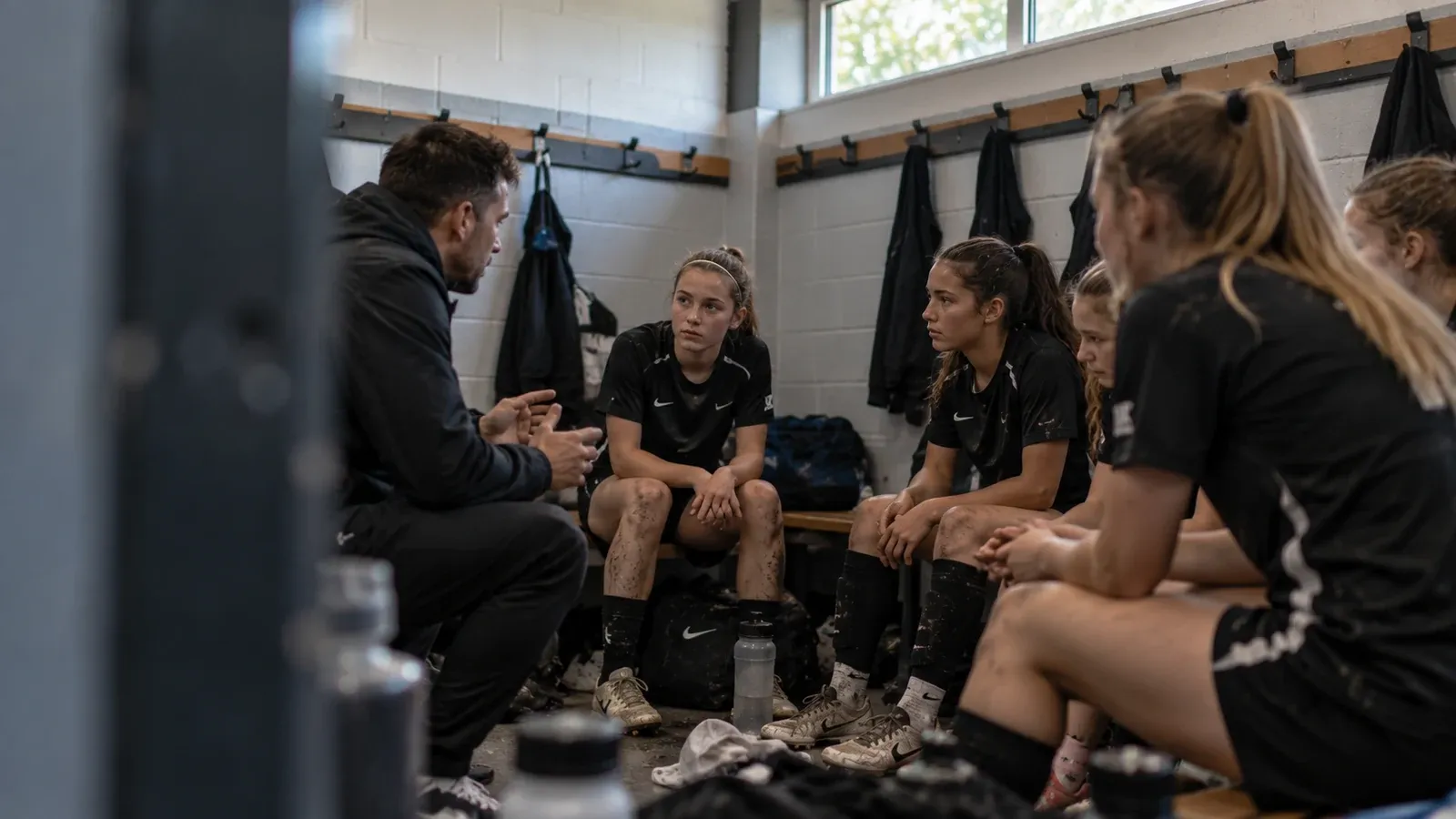

If a young player keeps fading in evening training, I would look at their school day before I started looking for a supplement.
Lunch might have been at 12.30pm.
Training starts at 6pm.
Nothing useful has been eaten in between.
By the warm-up, the player is already hungry.
That is what a lot of sports nutrition looks like in real life.
The biggest mistakes are rarely one terrible food. They are gaps in the day that keep happening.
Not enough food.
Poor timing.
Arriving at training hungry.
Forgetting to drink.
Focusing heavily on protein while eating too little carbohydrate.
Finishing late training with no plan for food afterwards.
Trying complicated supplements before sorting normal meals.
A 2026 scoping review of 57 studies involving 4,369 youth team-sport players found that reported energy and carbohydrate intake was often below recommendations, particularly during demanding training and competition periods. The researchers also found that food choices were affected by practical issues including time, food availability, cost and the influence of parents, coaches and peers. They were careful to point out limitations in the evidence too, including dietary under-reporting and inconsistent research methods.
That last part matters.
Knowing what to eat and managing to eat it during a normal week are two different problems.
Mistake 1: Looking at dinner when the problem started at lunch
Parents often see breakfast and dinner.
They do not always see what happened in between.
A player leaves home at 7.30am. They have school or college all day. Lunch is small, rushed or skipped. There is no useful afternoon snack. Training starts after school.
By dinner, they are starving.
Dinner gets blamed because the player eats a huge amount, but the problem started hours earlier.
I would map the day before changing individual foods.
Write down when the player wakes, eats, travels, trains and gets home.
The gaps become obvious.
Sports Dietitians Australia recommends that adolescent players adjust their eating patterns to daily exercise demands and get regular sources of carbohydrate and protein across the day.
For a lot of players, improving nutrition begins with filling one of those gaps rather than rebuilding their entire diet.
Mistake 2: Eating the same amount regardless of the day
A rest day and a tournament day do not ask the same thing from the body.
Neither do a light technical session and two hours of hard training.
Young players do not need to calculate every calorie they use. I would not want them doing that.
They do need to recognise that harder days usually need more fuel.
This might mean a bigger afternoon snack before a demanding evening session.
More food across a tournament day.
A proper recovery meal after a hard session.
Extra planning on a day containing school sport and club training.
The mistake is not failing to create a perfect periodised nutrition programme.
It is eating very little on the days when the player is doing the most.
Mistake 3: Arriving at training hungry and calling the poor session a fitness problem
This one is easy to misread.
The player starts well.
Later in the session, their intensity drops. Their decision-making looks slower. They complain that their legs feel empty.
The immediate reaction might be fitness.
Sometimes fitness is the problem.
Sometimes the player has been awake for ten hours and barely eaten since lunch.
Carbohydrate provides an important fuel source for higher-intensity exercise, and recent research into youth team sports has repeatedly reported carbohydrate intakes below recommended levels, although the quality of dietary measurement across studies is mixed.
Before deciding a player needs extra conditioning, look at what they did before training.
Our guide to what a young player should eat before competition goes deeper into fuelling before performance, but the same basic question belongs before training too.
Did they arrive with enough fuel to do the work?
Mistake 4: Treating carbohydrate as something to avoid
Young players hear conflicting messages about carbohydrate.
Bread makes you fat.
Pasta is bad.
Sugar is bad.
Eat high protein.
Eat low carb.
Then they try to train hard.
Carbohydrate is not a food group developing players need to fear.
Foods such as oats, rice, potatoes, pasta, bread, wraps, cereal and fruit provide useful carbohydrate within a normal diet.
That does not mean unlimited amounts of every carbohydrate-rich food are automatically helpful.
It means removing a major exercise fuel without a sensible reason is a poor starting point for a young player.
Sports Dietitians Australia’s adolescent guidance specifically recommends a regular spread of quality carbohydrate sources that reflects daily exercise demands.
The amount still depends on the player and the day.
Mistake 5: Making protein the whole nutrition strategy
Protein matters.
Young players need it for normal growth as well as repair and adaptation from training.
But protein has become so closely associated with sport that some players start judging every meal by how much protein it contains.
That misses the rest of the diet.
A player can hit a protein target and still eat too little overall.
They can have a protein shake after training and still have arrived at the session hungry.
They can buy high-protein snacks while barely eating fruit, vegetables or carbohydrate-rich foods.
Interestingly, the 2026 review of youth team-sport players found that reported protein and fat intake generally met recommendations, while reported energy, carbohydrate and several micronutrient intakes were more likely to fall short. The authors also warn that limitations in dietary reporting mean those findings should not be treated as exact estimates for every young player.
Protein belongs in the plan.
It is not the plan.
Mistake 6: Finishing training with no idea when food is coming
Training finishes at 8pm.
Home is 50 minutes away.
The player is hungry.
Nobody brought food.
Dinner has not been made.
Now it is 9.30pm and everyone is trying to solve a predictable problem while tired.
If this happens once, fine.
If training finishes at the same time every Tuesday and Thursday, the journey home is not a surprise anymore.
Take something.
Prepare dinner earlier.
Eat a suitable snack after training and have a smaller meal at home.
The best solution depends on the family.
Our guide to what players should eat after training explains how recovery changes depending on the session and how soon the player needs to perform again.
The important part here is simpler.
Do not repeatedly leave recovery to chance when you already know the schedule.
Mistake 7: Thinking competition requires completely different food
An important competition arrives and suddenly the player’s normal food is not good enough.
A special breakfast appears.
A new sports drink gets bought.
Somebody recommends a gel.
Another parent has a snack everyone else starts copying.
The player ends up trying foods they rarely use.
Competition is usually the worst time to experiment.
A familiar meal that the player knows they digest comfortably is more useful than a supposedly perfect performance meal that makes them feel sick.
This matters even more when nerves already affect appetite.
Tournament days and repeated events need more planning, but they still do not need a completely different diet. Our guide to what players should eat on a competition day covers how to adapt food around early starts, delays and several events without turning the day into a nutrition experiment.
Mistake 8: Only thinking about hydration when the bottle comes out
A large bottle does not prove a player is well hydrated.
Look at the rest of the day.
Did they drink at breakfast?
What happened at school?
Was it hot?
Did they arrive thirsty?
Are they training indoors or outdoors?
Do they sweat heavily?
Sports Dietitians Australia recommends that adolescent players have sufficient clean, cool fluid available before, during and after sport.
Fluid needs are still individual.
That is why our guide to hydration for young players focuses on the player, session and environment rather than giving every child the same daily bottle target.
Mistake 9: Trying to eat like a professional player
A professional posts their food online.
A developing player copies it.
What is missing?
Almost everything that explains why the professional is eating it.
Their body size.
Training load.
Age.
Competition schedule.
Energy requirements.
Performance goals.
Medical history.
What they ate earlier.
What they will eat later.
Whether the meal is part of an individual plan.
A developing player is also supporting growth and maturation alongside sport. Sports Dietitians Australia describes adolescent players as having unique nutrition requirements because those developmental demands sit alongside training and competition.
We cover this properly in why young players shouldn’t copy professional athletes’ diets.
Copying somebody else’s food is easy.
Understanding your own week is more useful.
Mistake 10: Reaching for supplements before fixing food
Supplements look like the advanced part of sports nutrition.
So players often want to start there.
Protein powders.
Pre-workouts.
Vitamin products.
Electrolyte powders.
Performance supplements.
Yet the young player might still be skipping breakfast and arriving at training hungry.
Sports Dietitians Australia’s adolescent position recommends meeting nutrient needs through core foods rather than placing unnecessary emphasis on supplements for developing players.
There are situations where a clinician or qualified sports nutrition professional recommends a supplement because there is a genuine need.
That is different from buying one because somebody online uses it.
Start with the diet.
Then solve specific problems specifically.
Mistake 11: Ignoring how the player feels because they are still performing
This is the mistake I would take most seriously.
A talented young player might continue performing while their nutrition is poor.
So adults assume everything is fine.
But look at the wider picture.
Are they constantly tired?
Has their mood changed?
Are they struggling to recover?
Are injuries becoming more frequent?
Are they deliberately restricting food?
Are they becoming anxious around eating or body weight?
Has expected growth or development become a concern?
For girls, have menstrual cycles become irregular or stopped?
These signs have several possible causes, so poor nutrition should not be diagnosed from a checklist.
They are reasons to pay attention.
The International Olympic Committee’s consensus on Relative Energy Deficiency in Sport describes how problematic low energy availability can affect health and performance across multiple body systems in both female and male players.
If there are concerns around growth, persistent fatigue, recurrent injury, periods, body image, deliberate restriction or disordered eating, I would move beyond internet nutrition advice and involve an appropriately qualified health professional.
The mistake underneath most of the others
There is a pattern running through nearly everything above.
Players start with the detail before the routine works.
They look for the best recovery product before planning dinner.
They worry about protein while missing meals.
They copy a professional diet before understanding their own training week.
They buy hydration products before remembering to drink through the day.
They search for a perfect competition meal after barely eating all morning.
The latest youth team-sport evidence adds something useful here. Nutrition knowledge alone does not seem to solve the problem. The 2026 scoping review found that education-only approaches rarely changed dietary behaviour, while practical barriers such as time, food access, cost and the home or sporting environment also shaped what players ate.
That sounds much closer to what families deal with.
A player might know they need to eat after training.
The problem is that training finishes at 9pm and home is an hour away.
So solve that problem.
A player might know breakfast matters.
The problem is that they get up late and have no appetite.
Solve that one.
A player might understand hydration.
Their school bottle still comes home full every day.
Start there.
Good sports nutrition is often less about knowing more and more about food.
It is about making the right food easier to eat at the times the player actually needs it.
The biggest mistakes are rarely one terrible food. They are gaps in the day that keep happening.Grantley Baugh, Founder of PlayerScout
Was this helpful?
 11 min