




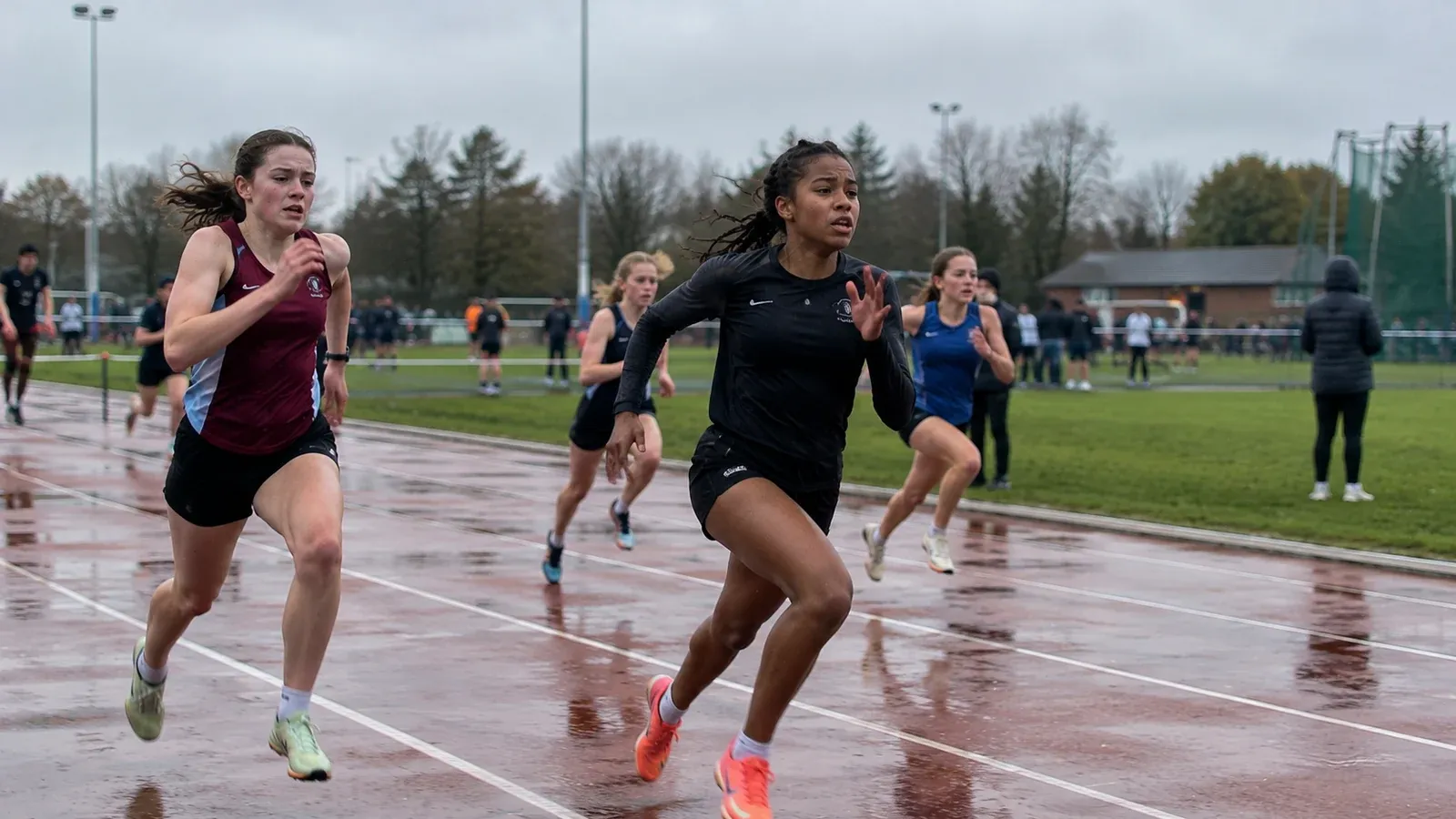
If a young player wants to get faster, they need regular opportunities to move fast.
That sounds simple, but a lot of supposed speed training does something else. Players run repeated shuttles until they are tired, spend long periods moving through ladders, complete circuits with very little rest or do hundreds of jumps. Those sessions might train useful qualities, but none automatically solves a speed problem.
Getting faster for sport usually involves a mixture of sprint exposure, strength, power, movement skill and enough recovery to produce high-quality efforts.
There is another part people miss.
First work out what “faster” needs to mean for the player.
A player who loses the first three metres has a different problem from one who reaches high speed slowly. A player who moves quickly in a straight line but struggles to brake and change direction needs something different again. And a player who tests well physically but always seems one step late during competition might have a perception or decision-making problem rather than a lack of running speed.
I would not start by looking for the best speed drill.
I would start by working out where the player is losing time.
Sport rarely gives every player the same speed problem
Watch how speed appears in competition.
Some players repeatedly accelerate from low speeds over short distances. Others get opportunities to open up into longer sprints. Some sports demand rapid stops and changes of direction. In others, a player reacts to an opponent, an object or a changing space before they move.
There are also sports where speed is expressed through the upper body or the whole body rather than through running alone.
So a 30-metre sprint time tells us something about a player.
It does not tell us everything about their sporting speed.
This distinction helps prevent wasted training. If the player needs better short acceleration, endless long-distance running is unlikely to be the most direct solution. If they already accelerate well but struggle to reach or maintain higher sprint speeds, their training problem has changed.
Speed needs a definition before it needs a programme.
If you want to sprint faster, sprinting needs to appear in training
Strength training helps. Plyometrics help. Technical work helps.
None removes the need to sprint.
A meta-analysis examining sprint training in male youth players found that sprint-focused interventions improved sprint performance overall. Responses differed across stages of maturation, and the research involved males, so the exact findings should not be treated as a universal prescription for every young player. The broader point is more useful: sprint performance is trainable.
Yet many players rarely sprint properly outside competition.
Sport practice might contain some high-speed movement, but drills, small spaces, tactical work and fatigue often limit how frequently a player reaches genuinely high running speeds.
A young player trying to improve speed therefore needs appropriate exposure to the thing they want to improve.
For acceleration, that might involve short, high-quality sprints from different appropriate starting positions.
For maximum-speed development, the player needs enough distance to accelerate and reach higher velocities safely.
The exact distances depend on the player and the sport. There is no reason to turn 10 metres, 20 metres or 30 metres into a universal youth prescription.
Speed training needs recovery
This is where speed training and conditioning often get mixed together.
Imagine a player runs a fast sprint, gets 15 seconds of rest and goes again. Then again. Then again.
The first repetition might be close to their best speed.
By the later repetitions they are fatigued, their times have slowed and the session has become something different.
That work might still have a purpose. Some sports require players to repeat high-intensity efforts while recovering between them.
But if the aim is developing maximum sprint quality, fatigue should not be allowed to dominate the session.
The player needs enough recovery to produce another high-quality effort.
That often makes good speed training look less exhausting than people expect. There might be fewer repetitions, longer rests and less visible suffering.
Do not judge a speed session by how tired the player looks afterwards.
Judge whether they spent useful time moving fast.
Acceleration and maximum speed are related, but they are not identical
The first few steps of a sprint are different from running once the player is upright and moving at much higher velocity.
During early acceleration, the player is trying to increase velocity quickly from a low starting speed. As the sprint continues, posture and mechanics change until the player approaches their highest speed.
A player might be excellent over the first five metres without being the fastest over 30 metres.
Another might take longer to get moving but become much quicker once they reach higher speeds.
Sport decides how much each quality matters.
A court player working repeatedly in small spaces might place greater emphasis on short acceleration than someone whose sport regularly provides longer running distances. That does not mean maximum-speed exposure has no value for the first player. It means the programme should reflect what they repeatedly need to do.
Testing different sprint distances sometimes helps separate those qualities rather than giving every player one label of “fast” or “slow.”
Strength gives speed more force to work with
A sprint is a physical action.
The player has to apply force against the ground quickly enough to move their body.
That is one reason strength training belongs in a speed programme.
A systematic review and meta-analysis of resistance training in youth players found improvements not only in strength and jumping performance but also smaller positive effects on linear sprint performance.
The word “smaller” matters.
A player does not become fast simply because their gym numbers rise.
Strength provides physical capacity. Sprinting still requires the player to express force quickly, coordinate the movement and direct that force effectively while running.
If a player is physically weak, improving strength might remove an important limitation.
If they are already strong and their sprint performance has stopped improving, adding more strength without looking elsewhere might solve very little.
Article 21 on strength, speed and power explains how these qualities overlap without being interchangeable.
Power helps bridge the gap between being strong and moving quickly
Sport rarely gives players unlimited time to produce force.
They need to accelerate, jump, strike, throw or change direction quickly.
That is where explosive training becomes useful.
Plyometric exercises such as appropriately selected jumps, hops and bounds provide one way of training rapid force production. A 2026 systematic review and meta-analysis covering 63 studies found plyometric training improved sprint, jump and agility outcomes in adolescents aged 10 to 19. A separate systematic review focused on children also reported improvements across sprint distances from 5 to 30 metres following plyometric jump training.
The practical response is not to add enormous volumes of jumping to every programme.
A young player needs enough exposure to create adaptation while maintaining movement quality and fitting the work around everything else they already do.
For one player, a few well-executed jumps before sprint work might be useful.
Another player with more training experience might use a more developed plyometric programme.
The method changes with the player.
Sprint technique matters, but do not turn running into a maths lesson
Young players sometimes get so many sprinting instructions that running stops looking natural.
Push here.
Lift this higher.
Put the foot there.
Hold this angle.
Move the arms like this.
There are technical features coaches look at in sprinting, and individual mechanical problems sometimes deserve specific coaching.
But the player still has to run fast.
Technical work should help the movement rather than fill the player’s head with six body positions while they sprint.
I would usually rather identify the most useful limitation, give the player a clear task and see whether the movement improves.
Some technical changes also emerge as the player’s strength, coordination and exposure to fast sprinting improve.
Technique matters.
So does letting the player sprint.
Resisted sprinting is a tool, not the secret to speed
Sleds and other forms of resisted sprinting are popular because they provide additional resistance while the player accelerates.
There is evidence supporting their use.
A 2024 systematic review and meta-analysis found resisted sprint training improved acceleration, but when compared with the same volume of unresisted sprint training, the overall difference was small and did not reach statistical significance. More recent evidence across broader populations suggests certain heavier resisted-sprint methods might provide additional acceleration benefits, particularly in trained populations.
That is a much more useful picture than “sleds make you faster.”
Resisted sprinting gives a coach another training option.
A young player does not need a sled before they have earned the right to call their programme speed training.
Normal sprinting still works.
I would not start by looking for the best speed drill.Grantley Baugh, Founder of PlayerScout
Ladders train what you do in the ladder
Agility ladders are not useless.
They might provide a warm-up, coordination challenge or a way to practise a particular foot pattern.
The mistake is assuming quick feet through a fixed ladder pattern automatically produce faster sprinting.
Moving the whole body rapidly requires the player to apply force and cover distance. A ladder often encourages many small steps with little horizontal displacement.
If the player wants to sprint faster, some training needs to involve sprinting.
If they want to change direction faster, some training needs to involve braking and reaccelerating.
If they want to react faster in competition, some training needs to involve information they have to perceive and respond to.
The drill should resemble the problem closely enough to justify the time spent on it.
Braking is part of being fast in many sports
Players often think only about how quickly they accelerate.
In many sports, getting somewhere fast also depends on stopping.
A player who approaches a movement quickly but needs several extra steps to control their body loses time before the next action.
Change-of-direction ability depends on several physical and technical factors, and current research in adolescent team-sport players supports multiple training methods rather than one universal solution. A 2025 network meta-analysis covering 36 studies and 1,125 participants found meaningful improvements from several approaches, with responses differing according to the type and angle of change of direction.
For a developing player, that means speed training sometimes needs to include learning how to decelerate, control the body and produce force in a new direction.
Running faster into every situation is not useful if the player cannot organise what happens next.
Reactive speed is different again
Put two players through a pre-planned course and one might clearly be faster.
Now put an opponent in front of them and remove the pre-planned route.
The result might change.
Real agility in many sports includes a perceptual problem. The player needs to pick up information, decide what matters and coordinate their movement in response.
Recent systematic-review evidence in team-sport players reinforces the importance of this perception-action coupling when agility is trained rather than treating agility as pre-planned change of direction alone.
This explains something parents and coaches sometimes notice.
A player looks quick in testing but slow in games.
Their legs might not be the problem.
If they recognise the situation half a second late, physical speed has already lost some of its value.
That type of player needs sporting situations that improve how quickly they perceive, decide and move, rather than another set of straight-line sprint drills alone.
Growth changes the speed picture
Speed comparisons during adolescence need care.
A 2025 systematic review and meta-analysis found sprint and jump performance generally improved across advancing maturity groups, with moderate to large differences in sprint performance between pre- and post-peak-height-velocity groups.
That does not mean every later-maturing player will eventually become faster than every early maturer.
It means biological development affects the physical qualities we are measuring.
A player who suddenly looks slower relative to teammates might not have become worse. Other players might be moving through maturation earlier, or the player’s own rapidly changing body might temporarily alter how movement feels and looks.
Article 18 on how young players actually progress in sport explains why a snapshot of youth performance should not be confused with a final judgement about potential.
Keep training the player in front of you rather than chasing somebody else’s development clock.
Extra body mass has to be moved too
Speed involves moving the player’s own body.
That makes body mass relevant, but this needs sensible handling with young people.
Growing players are supposed to gain size.
Puberty changes height, muscle mass and body composition.
I would not respond to a young player’s speed problem by putting them on a weight-loss plan without a genuine clinical or performance reason and appropriate professional support.
Instead, look at whether their strength and power are developing alongside their changing body.
A player might gain substantial body mass during growth and temporarily find acceleration harder. Building the physical capacity to control and move that new body is part of development.
The scale alone does not tell you what needs fixing.
More sprinting is not always the next answer
There is a point where adding sprint volume becomes lazy programming.
Suppose the player already receives regular high-quality sprint exposure.
They are technically competent.
They are rested when they sprint.
They are physically strong.
They have appropriate power training.
Yet their speed has stopped improving.
Now we need to investigate rather than adding repetitions.
Perhaps the strength programme needs changing.
Perhaps a mechanical limitation is worth addressing.
Perhaps the player needs a different sprint stimulus.
Perhaps the sporting problem is reactive rather than linear.
Perhaps they are carrying too much fatigue from the rest of their week.
Article 20 on how often young players should strength train deals with the same wider programming principle. One training quality never sits completely on its own.
You do not need expensive equipment to start getting faster
A useful youth speed programme does not begin with timing gates, force plates, specialist treadmills or a long list of gadgets.
Those tools have uses.
They are not prerequisites.
A suitable surface, enough space, sensible coaching and a way to repeat high-quality sprinting already give a player plenty to work with.
Even timing does not need to become complicated at first.
If reliable sprint timing is available, it helps track progress and tells the coach when performance is dropping during a session.
Without it, the coach still watches movement quality, intent and fatigue.
Equipment improves measurement.
It does not replace training.
A simple speed session should have a clear job
Before a player starts, I would want them to know what the session is trying to improve.
If the priority is acceleration, the session might use a small number of short sprints with generous recovery, supported by appropriate strength and explosive work elsewhere in the programme.
If the priority is higher-speed running, the distances and build-up need to give the player enough room to reach those speeds.
If the sporting problem is changing direction, braking and reacceleration need attention.
If the player is physically quick but reacts slowly, the session needs an information source rather than another predetermined route.
You do not need all of those in every session.
You need the right problem.
The fastest programme is the one the player is ready for
There is no single drill that makes every young player fast.
Some need more strength.
Some need more exposure to sprinting.
Some need better acceleration.
Some need power.
Some need to learn how to brake.
Some are already physically quick and need to read the sport earlier.
The answer also changes as the player grows.
So if I were trying to make a young player faster, I would not begin by asking what drill is trending or what a professional player is doing.
I would watch them move.
I would work out where they are losing time.
Then I would train that problem while continuing to build the physical qualities that give speed somewhere to come from.
Was this helpful?