



There is no single checklist that every coach or scout uses to identify a promising young player.
A swimming coach assessing a 14-year-old has a different job from somebody recruiting a basketball player. A tennis programme, athletics pathway, rugby academy and gymnastics coach will value different physical and technical qualities. Even within one sport, the requirements change with the player’s age, role, level and the type of opportunity being offered.
So I would be careful with anybody promising to reveal the five things every scout looks for.
The better answer is that coaches and scouts are usually trying to understand a combination of what the player can do now, how they solve the problems their sport gives them, and what they might become with further development.
Research across talent identification supports this multidimensional view. Technical, tactical, physical, physiological and psychological characteristics all appear in the literature, but their importance varies substantially between sports and populations. A systematic review of talent identification in elite sport found considerable variation in which factors separated more and less skilled performers and concluded that there was no clear set of variables consistently predicting future success.
That uncertainty is important for young players and parents to understand.
Being noticed is not the same as having your future accurately predicted.
The first question is what the sport requires
Before worrying about scouts, start with the sport.
What does successful performance actually require?
In some sports, speed, power, endurance or body dimensions have a strong relationship with competitive performance. In others, technical precision, tactical decisions, anticipation or the ability to adapt to an opponent carry more weight. Most sports involve several of these qualities interacting.
Even apparently similar sports differ.
A systematic review of racket-sport talent development found evidence supporting physiological and technical characteristics, while evidence around psychological and tactical characteristics was more limited. Basketball research has identified height, body mass and several physical-performance measures as relevant discriminators between groups, while team-sport research shows that the physical and technical demands themselves differ considerably between sports.
There is no useful universal answer such as “scouts want fast players” or “coaches only care about technique.”
They want qualities that help somebody perform and develop in their sport.
The starting point for a young player should therefore be understanding the demands of their own event, discipline, position or role rather than trying to look like somebody’s idea of a talented player.
Coaches are watching what you do with your ability
A player might have an obvious physical quality.
They are quick.
Tall.
Strong.
Explosive.
Flexible.
They might have a technical quality that immediately stands out too.
None of that tells the whole story.
The more interesting question is what happens when those qualities have to solve a real sporting problem.
A fast player still has to know when to use their speed. A technically gifted player still has to select the right action. A strong player needs to apply that strength in situations that matter. A player with excellent movement quality still has to reproduce it when timing, pressure or fatigue changes.
In sports with opponents and changing environments, this becomes particularly important because the player has to perceive information before acting.
Research into coach decision-making in talent identification has found that coaches’ judgements often include ideas such as game intelligence alongside physical and technical ability. That research also shows how much selectors rely on experience and tacit judgement rather than one objective score.
For the player, the practical lesson is not to perform for the scout.
Play the sport.
Show what your qualities allow you to do.
Decision-making is difficult to fake
This is one reason a player does not always need to dominate the competition to be interesting.
Imagine a player receives the ball three times.
The first time, they play quickly because pressure is arriving.
The second time, they recognise space and carry forward.
The third time, they leave the ball for a teammate in a better position.
There might be nothing spectacular in the clip, but the player is showing information processing and decision-making.
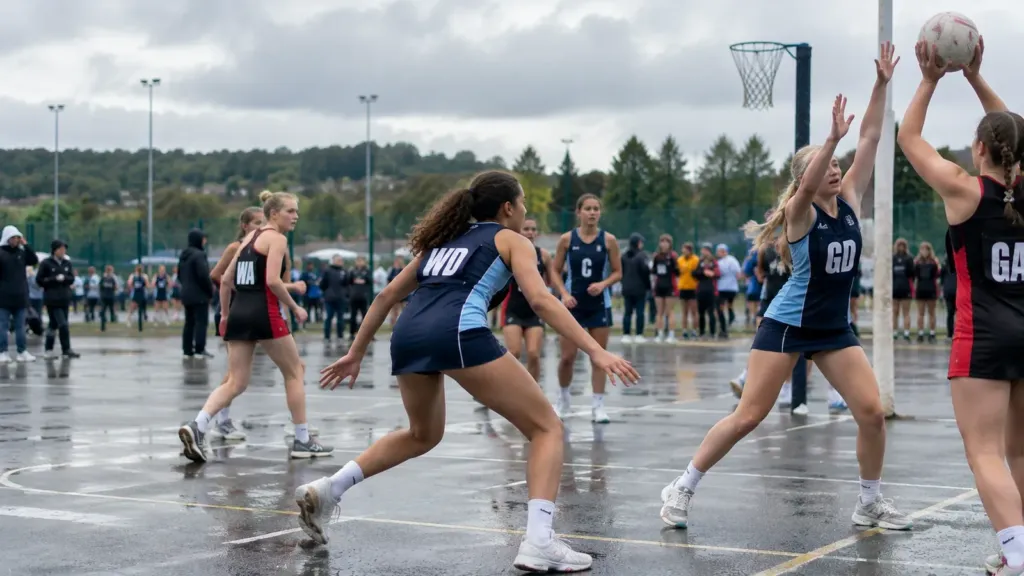
The same idea appears differently across sports. A racket player recognises when to change the direction or pace of a rally. A combat-sport player responds to distance and an opponent’s movement. A racing driver changes their approach as grip or traffic changes. A netball player creates space before receiving rather than reacting after the pass has already been made.
Good performance is full of decisions that do not look dramatic.
Players sometimes become so focused on being noticed that they start forcing difficult actions because those actions look more impressive.
That can hide the exact quality an experienced observer wants to see: whether the player understands what the situation requires.
Technical ability matters more when it survives the real sport
Technique matters in virtually every sport, although what good technique means differs enormously.
A scout or coach is rarely interested only in what the movement looks like without context.
Can the player execute when the situation becomes harder?
Does the technique hold up when speed increases?
What happens when an opponent interferes?
Can they adjust when the first option disappears?
Does fatigue change the movement?
Can they reproduce the skill rather than showing it once?
A systematic review examining technical-skill assessment in talented young players found considerable variation in how technical qualities are measured across sports, which is another reason universal scouting tests should be treated cautiously.
For players, the important distinction is between owning a skill and demonstrating it in an ideal situation.
The competition version matters.
Physical qualities are real, but development complicates what scouts see
This is one of the biggest problems in youth selection.
At 12, 13, 14 or 15, two players in the same age group might be at quite different stages of biological development.
One might already have gained considerable height, muscle mass and strength. Another might be months or years behind in maturation.
That affects what an observer sees today.
Relative age adds another complication. When players are grouped by annual age bands, somebody born near the beginning of the selection year might have a meaningful developmental advantage over somebody born near the end.
These effects are not theoretical quirks. Relative-age effects have been documented across multiple sports, and recent evidence continues to find selection imbalances in youth pathways. A 2026 study of players invited into Basketball England national squad selection camps, for example, found an overrepresentation of players born earlier in the selection year in both male and female groups.
The size and pattern of these effects differ between sports, sexes, ages and systems, so we should not use them to explain every selection decision.
They do tell us something important.
The player who looks physically superior today is not automatically the player with the greatest long-term potential.
Potential is much harder to judge than current performance
This distinction sits underneath almost everything in youth scouting.
Selecting the best performer today and identifying the player most likely to become excellent in five or ten years are not the same task.
Current performance is visible.
Future development is not.
Growth changes players. Coaching changes them. Motivation changes. Opportunities differ. Injuries happen. Some players improve rapidly and then plateau. Others develop much later.
The problem is visible in the research. A systematic review of talent identification found high variability in the factors distinguishing skilled from less-skilled performers and highlighted the limited state of knowledge around predicting future elite performance.
More recent work has moved towards multidimensional and longitudinal approaches for exactly this reason.
A player’s current level matters. Coaches have teams to select and competitions to enter.
But a good development system also needs to ask whether the qualities being observed are likely to grow, transfer and remain useful as the standard increases.
Coachability is more useful when you turn it into behaviour
Players hear this word constantly.
“Be coachable.”
That sounds sensible, but it needs explaining.
Coachability should not mean agreeing with everything a coach says, never asking questions or behaving like the quietest person in the group.
A 2025 systematic review examined more than five decades of literature on coachability and identified six recurring components: paying attention to information, willingness to learn, persistence after setbacks, seeking feedback, receiving feedback and acting on feedback.
I like that definition because players can do something with it.
If a coach gives you a correction, do you understand it?
If you do not understand it, do you ask?
Do you attempt the change?
If the first attempt fails, do you keep working on it?
When the coach comes back ten minutes later, are you still trying to apply the information?
That gives a coach much more useful evidence than nodding while they speak.
There is an important research limitation here. Coachability is widely valued, but the 2025 review also found inconsistent definitions and limited standardised assessment. We should not pretend there is a proven coachability score that predicts who will become elite.
It is better treated as a set of useful learning behaviours.
How you respond when things go wrong gives people information
Nobody needs to make a deliberate mistake so a scout can watch their reaction.
Sport will provide enough mistakes on its own.
What happens afterwards is informative.
Does the player remain involved?
Can they take feedback without disappearing emotionally?
Do they blame everybody around them?
Do they rush to compensate?
Can they adapt when the original plan stops working?
Our guide on how to recover quickly after a mistake deals with the performance side of this in more depth.
From a scouting perspective, I would not turn one frustrated reaction into a judgement about somebody’s character. Young players are learning emotional skills as well as sporting ones.
Patterns are more useful than moments.
One poor reaction tells you what happened once.
Repeated behaviour across different situations tells you more.
Scouts do not all see the same player
This is worth understanding because selection can feel strangely inconsistent.
One coach loves a player.
Another does not select them.
A scout watches once and shows no interest. Somebody from another programme sees them later and wants another look.
That does not automatically mean one person is incompetent.
Evaluation contains judgement.
A systematic review and meta-synthesis of coach knowledge in talent identification found that coaches frequently relied on what researchers described as instinct, informed by qualities including drive and ambition, game intelligence, and physical and technical skills.
That instinct comes from experience, but subjective judgement also creates room for disagreement and bias.
The selection question matters too.
A coach choosing somebody to help win this weekend might value different things from a development programme considering who has potential several years from now.
Players should take selection seriously without assuming every evaluator will reach the same conclusion.
Players should take selection seriously without assuming every evaluator will reach the same conclusion.Grantley Baugh, Founder of PlayerScout
One observation should not tell you everything
This is another reason I dislike the idea of players trying to perform a special “scout version” of themselves.
A single observation is a small sample.
Maybe the player barely receives the ball.
Maybe the event does not expose their strongest quality.
Maybe they are returning from illness.
Maybe the opponent creates a particular tactical problem.
Maybe they have an outstanding day that is not representative either.
Good talent identification increasingly points towards multidimensional and longitudinal assessment rather than judging potential from one characteristic at one moment.
A 2026 systematic review examining machine-learning approaches in youth team-sport talent identification reached a similar caution from a different direction. Models using combinations of anthropometric, physical, technical, perceptual-cognitive, psychological and contextual information showed promise, but external validation was uncommon and risk of bias was high in many studies. The authors concluded that such models should support rather than replace human decision-making.
More information does not make predicting a young player’s future easy.
It gives selectors more evidence to work with.
Do scouts care about attitude?
Yes, but I would want to know what somebody means by attitude.
The word gets used far too loosely in youth sport.
Sometimes “good attitude” means the player works consistently, listens, supports teammates, responds to feedback and stays engaged when things become difficult.
Sometimes it means the player has the personality an individual coach prefers.
Those are not the same thing.
Research on coach knowledge has identified drive and ambition among the qualities informing talent judgements, while sport-specific scouting studies have also reported discipline, coachability and positive attitude among attributes selectors say they value.
The newer evidence around coachability helps make some of this observable.
Instead of trying to look enthusiastic every second, show behaviours that help development.
Prepare properly.
Pay attention.
Ask useful questions.
Apply feedback.
Stay involved when the session becomes difficult.
Those behaviours make sense even if no scout is watching.
You do not need to become louder to show leadership
Some players worry they are too quiet to get noticed.
Communication matters in sports where players need to exchange information, organise others or coordinate actions.
But leadership is not a volume competition.
A player might lead by communicating early, helping a teammate, staying composed, recognising a problem, taking responsibility or setting a reliable standard in training.
The behaviour needs to make sense for the sport and the player.
I would never tell a naturally quieter young player to spend an entire trial shouting because they think that is what a scout wants.
An evaluator interested in genuine communication will notice fairly quickly when the noise contains no useful information.
Do not spend the competition checking who is watching
The moment a player starts performing for the scout, their attention has moved.
They attempt things they would not normally attempt.
They check the side after a good action.
They worry about mistakes because somebody important might have seen them.
They start evaluating their own performance while they are still trying to perform.
That creates exactly the kind of problem covered in how to stop overthinking during competition.
If a scout is there, let them do the scouting.
The player’s job has not changed.
Parents should not try to manage the scouting performance from the side
Parents understandably want their child to make the most of an opportunity.
That can turn the day into something much bigger than it needs to be.
“Make sure you work hard.”
“Show them what you can do.”
“Don’t try anything silly.”
“Talk more.”
“They’re watching you.”
Now the player has the sport to deal with and a list of instructions about how to look selectable.
I would rather the player arrive knowing what their normal job is.
If the opportunity goes well, good.
If it does not, find out what was learned.
Article 12 on how to handle being dropped, benched or not selected becomes particularly useful when an opportunity ends without the decision the player wanted.
A pathway contains selection decisions. Learning to deal with them is part of staying in one.
What should a young player work on if they want to get noticed?
I would not build a player’s development around attracting scouts.
Build a better player.
Understand the qualities your sport and role require. Improve the technical skills that allow you to perform them. Develop the physical qualities appropriate to your age and sport. Learn to recognise situations and make decisions. Listen to good coaching and show that you can apply it. Compete properly when the situation becomes difficult.
Then let selectors decide what they see.
Some will value you more than others.
Some decisions will be right for where you are now. Some will look different with time.
The evidence around talent identification gives us good reasons to be humble about prediction. Even sophisticated systems struggle to reduce a developing player to a reliable forecast of future performance.
For a young player, that takes some pressure out of the question.
You do not need to work out how to look talented.
Give people better evidence of the player you are becoming.
Was this helpful?
 13 min